
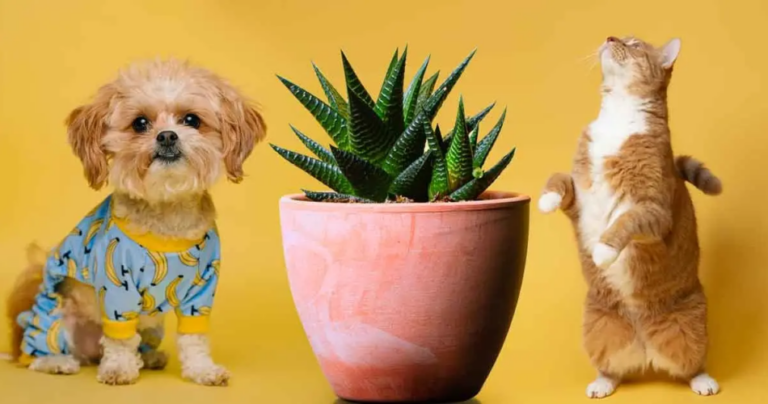
Can our pets live with our houseplants? Good question. Yes, let’s be clear, when a plant dies, it can easily be replaced. However, our furball is a full-fledged member of the family: when it gets sick, for example, it’s general panic. We have such affection for our pets that we cannot skimp on their health or safety. Moreover, when thinking about installing plants at home, the first condition is to first know if these plants are not dangerous for animals, but also for children. Because in fact, some are very toxic and can trigger diseases. Prevention is better than cure…
You can convince us that your poodle is very intelligent and very well-trained, but you can’t be sure that once we turn our backs, he won’t want to venture into an attractive plant. He jumps everywhere, and all he needs to do is nibble on a leaf to give him a bad time: diarrhea, vomiting, palpitations, or worse. Why put him in the lion’s den? To ensure the safety of your dog or cat, we checked the ASPCA’s Pet Safe Plant Index. Of course, these varieties aren’t necessarily edible, but at least they’re plants that are safe for our four-legged friends.
How can you add a touch of green to your decor without poisoning your pets? Discover this selection of 10 stunning indoor plants that are both lush and non-toxic.
Also read: Which houseplants are toxic to cats?
porcelain flower
The porcelain flower (Hoya Carnosa)
Perfect for indoor growing: The “wax flower” is distinguished by its glossy, oval, green leaves and wonderfully fragrant, star-shaped nectar-bearing flowers. These flowers grow in waxy clusters ranging from pink to white and produce a very delicately scented nectar. A big plus is that this plant is not poisonous. The advantage is that it tolerates very dry conditions perfectly and requires little watering, once or twice a week in summer. Of tropical origin, this perennial plant is easy to grow, can live a long time, and thrives very well indoors. A special feature: unlike others, you don’t have to remove your faded flowers, as others may appear in their place.
flytrap
Venus flytrap (Dionaea Muscipula)
Well known for its carnivorous nature, this plant is strangely beautiful, lined with eyelash-like teeth that come together when activated by prey. Rest assured, it won’t eat any member of the family, but instead will get rid of the flies and other small insects it feeds on. Native to North America, specifically the swamps of South and North Carolina, it thrives in bright light and a humid environment. Attractive, the Venus flytrap is completely harmless to pets. Place it near a window, water it occasionally, and give it at least 4 hours of direct sunlight per day.
haworthia
Haworthia
A highly aesthetic succulent plant from the succulent family, Haworthia resembles a spineless cactus with long, pointed leaves. This low-growing plant features distinctive white dotted bands on its leaves. Easy to care for, Haworthia requires little water and plenty of indirect light. This plant thrives in moist conditions with good soil drainage. Its shape and size resemble Aloe Vera, but unlike that plant, it is safe for dogs and cats.
African violet
African violet (Saintpaulia)
With its fluffy green leaves and abundant annual flowers, the African violet is a member of the Gesneriaceae family. Depending on the variety of shapes and colors, its flowers come in a sumptuous shimmering palette ranging from white, blue, yellow, pink, red, or purple. Some are also sometimes varied and very pleasing to the eye. Ideally, it should be placed near an east- or west-facing window. Also known as the “Queen of Houseplants,” it thrives at a temperature maintained between 18 and 24°C. Easy to grow, its flowers are not at all toxic to dogs and cats. The African violet is therefore perfect for those looking for a low-maintenance houseplant.
nephrolepis
Boston fern (Nephrolepis exaltata)
Much loved for its curly green leaves, the Boston fern is a classic beauty that adds a touch of charm to any room. This plant thrives best in a cool spot with high humidity and indirect light. Not only is it a very easy type of fern to care for, but as a bonus, it’s also safe for pets.
Christmas Cactus
Christmas cactus (Schlumbergera)
With their flamboyant, trumpet-shaped flowers in the middle of winter, Christmas cacti are a true addition to any home. They offer a beautiful display in winter with blooms of different colors. These succulents are very accommodating: they require little care and adapt easily to low-light conditions. Be careful: if its leaves turn red, it means that the Christmas cactus is getting too much sun. It likes light but not direct sunlight. Alternating periods of light and darkness is essential to encourage beautiful flowering. Also, remember to keep the soil fresh with regular watering. And the good news is that this plant is not toxic to animals.
platycerium
Elkhorn fern (Platycerium bifurcatum)
A type of air plant, this fern grows best when mounted on a board and hung on a wall to benefit from air and humidity. With its moose-like fronds and imposing silhouette, it presents a rather fascinating and intriguing appearance. A living work of art, this plant has become very popular in interior decoration. Not to mention, it is not at all toxic or dangerous to animals!
palm
The parlor palm (Chamaedorea elegans)
As its name suggests, the parlor palm is the ultimate houseplant. Able to withstand low light and low temperatures, this palm grows in clusters with elegantly arching green leaves forming a feathery canopy. It also produces small yellow flowers resembling mimosa, which turn into small berries. Native to Mexico, also known as the “dwarf palm,” this plant thrives in both shade and heat. It grows indoors and is easy to care for. It’s especially reassuring to know that this palm, which adds a truly tropical touch to the decor, won’t harm your furry friends. Place it in a bright room and let the soil dry out between waterings.
Also read: 5 reasons to use bicarbonate on plants
guinea fowl bread
Guinea sorrel (Hibiscus sabdariffa)
Adding a tropical touch to your home is a breeze with this beautiful plant. Thrives in direct sunlight. While it can be difficult to maintain when grown outside of temperate climates, once you tame it and know how to care for it properly, it will reward you with bright, showy flowers that are perfect for your pets. Also called “Karkade,” native to Africa, this type of Hibiscus also has anti-inflammatory, analgesic, and tonic properties.
Chlorophyte
Spider plant (Chlorophytum)
With gracefully trailing, grass-like leaves, the spider plant is very hardy and able to grow in a wide range of conditions. Its creamy variegated foliage forms long, elastic, dangling ribbons. This tough, dirt-resistant plant is perfect for hanging: it produces tiny spiders that wrap themselves around the mother plant like a web. Provide minimal light without direct sunlight. The upside is that this plant tolerates drought better than overwatering. And it’s completely safe for all your little housemates!
Also read: Pour turmeric on your plants and see what happens. The favorite remedy of experienced gardeners.