
Bittercress (Cardamine hirsuta): A small, leafy green with a peppery taste, perfect for spicing up salads.
Chickweed (Stellaria media): Known for its bright green leaves, chickweed is excellent in salads and rich in phosphorus, calcium and iron.
Dandelions (Taraxacum officinale and Taraxacum erythrospermum): The tender leaves add a tangy flavor to salads and their flowers can be eaten raw or used in dandelion wine.
Dead nettle (Lamium purpureum): Plant with purple flowers whose leaves can be cooked or eaten raw.
Dock (Rumex crispus – curly dock and Rumex obtusifolius – broadleaf dock): Contains large, prickly leaves that can be cooked like spinach.
Henbit (Lamium amplexicaule): Offers a mild, grassy flavor and can be used in salads or as a cooked green.
Japanese Honeysuckle (Lonicera japonica): Contains a sweet nectar and can be used to make tea or syrup.
Lamb’s-quarters (Chenopodium album and Chenopodium berlandieri): A nutritious green, containing three times more calcium and twice as many nutrients as spinach.
Amaranth Amaranth (Amaranthus spp.): Can be used in the same way as spinach, raw and cooked.
Plantain (Plantago spp.): The leaves are best eaten young and can be used in salads or as cooked green vegetables.
Purslane (Portulaca oleracea): A succulent herb rich in omega-3 fatty acids, vitamins, and minerals, with a flavor similar to spinach and okra.
Sheep sorrel (Rumex acetosella): Has a lemony flavor and mixes best with other green vegetables in salads.
Stinging nettle (Urtica dioica): Must be cooked to remove the stinging hairs and is rich in vitamins and minerals.
Thistle (Cirsium horridulum and others): Although hard, the inner pith can be eaten raw or cooked.
Shepherd’s Purse (Capsella bursa-pastoris): Named for its heart-shaped pods, it is best eaten cooked green before the pods develop.
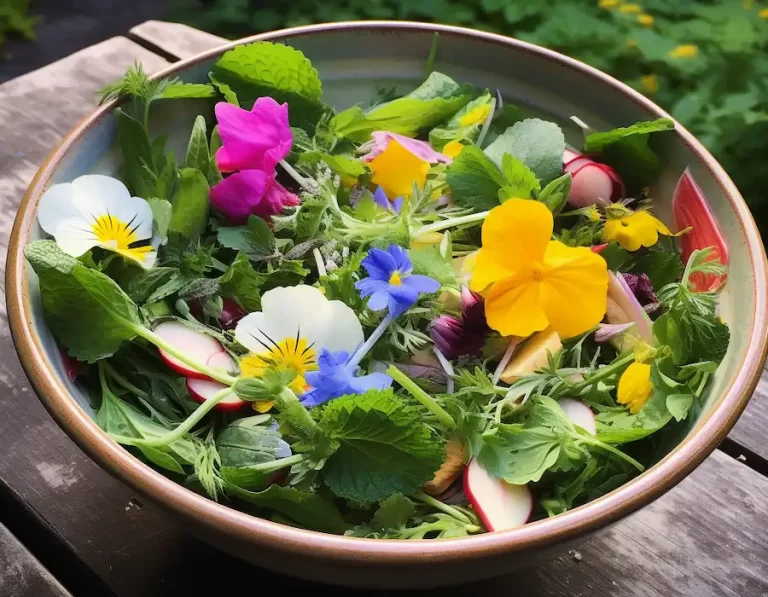
a bowl of edible herbs
Additional edible weeds not in the top 15:
Amaranth
Burdock
Chicory
Cress
Closed quay
Galinsoga
Garlic Mustard
Stinging nettles
Violets and viola
Wild garlic
Wood sorrel
Safety first:
a bowl for washing herbs
Always positively identify plants before consuming them.
Avoid foraging in areas that may have been treated with chemicals or are frequented by animals.
When in doubt, consult local experts or resources like James A. Duke’s “Handbook of Edible Weeds.”
This guide serves as an introduction to the world of edible weeds, highlighting some common varieties you might find in your garden. Each plant offers unique flavors and nutritional benefits and can be a wonderful addition to your diet. However, always remember to eat responsibly and safely.