
They’re ready to end up in the trash but have gardening powers if you know how to use them. They’re also easy to prepare at home in a few steps and without effort. It could be a small greenhouse, a fruit picker, a vegetable box, or a self-watering planter… these are all great ideas for your garden. Save them and try some for your garden now. Here we are!
No. 1 Temporary protection of vegetables
18 Brilliant Free Garden Hacks – 115
Recorder
Source: Good Spirits
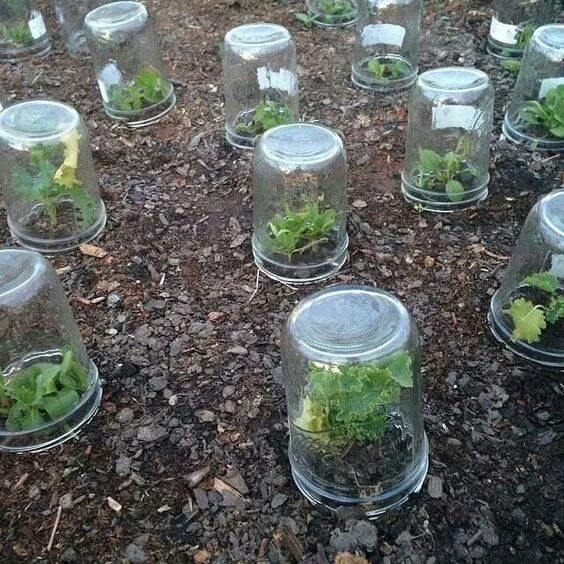
As any gardener knows, nature can be unpredictable. From sudden drops in temperature to hungry creatures, our precious harvest can face a variety of threats. If you need a simple yet ingenious solution that stands out to protect your garden’s bountiful harvest, enter the humble glass jar. These iconic glass containers have been a kitchen staple for generations, but their versatility extends far beyond simple storage.
And here are some useful ones that these glass keepers play a vital role in ensuring the growth of your vegetables, as frost fighters, pest shields, mini greenhouses, microclimate managers, reusable and environmentally friendly.
Simply place the mason jars over individual plants in your garden. Make sure the jars completely cover the plant and gently press them into the soil to create a seal. Remove the jars in the morning when the temperature rises to avoid overheating the plants. At the same time, allow sunlight and rain to reach the plants.
2 Zero Dollar Lattice
18 Brilliant Free Garden Hacks – 117
Recorder
Source: The Deliberate Agrarian
If you’re looking for creative and budget-friendly gardening solutions, consider repurposing old bicycle wheels to create a free trellis for your garden. This ingenious DIY project not only adds a touch of whimsy to your outdoor space, but also provides valuable support for climbing plants, transforming your garden into a lush, green paradise.
Materials needed: old bicycle wheels, paint (optional), paintbrushes (if painting), screws and anchors (for assembly), string or garden wire (for plant support).
How to do it:
Step 1: Thoroughly clean your old bike wheels, removing any dirt or rust. If desired, paint the wheels in the color of your choice. Let them dry completely.
Step 2: Select a suitable location in your garden where you want to install the trellis. Make sure it is close to the climbing plants you plan to support.
Step 3: Securely attach the bike wheels to a fence, wall, or sturdy wooden posts using screws and anchors. Make sure they are at a height that allows your plants to climb freely.
3 Low-tech gravity drip irrigation
18 Brilliant Free Garden Hacks – 119
Recorder
Source: Sustainable Agriculture
This system is an efficient and economical way to water your plants, especially in areas with limited access to electricity or pressurized water sources. This system relies on the force of gravity to deliver a slow, steady flow of water directly to your plants’ root zones. It is especially useful in areas where water access is limited or electricity is unavailable.
Materials needed: plastic bottles (2 liters or similar size), a sharp tool (scissors, utility knife, or drill), garden hose or garden hose, garden stakes or supports, water source (elevated, such as a raised surface or a hook).
How to do it:
Step 1: Using a sharp tool (scissors, utility knife, or drill), create small holes in the bottom of each bottle. These holes will allow water to drain.
Step 2: Attach the hooks or hanging brackets to a suitable structure, such as a wall, fence, or trellis, near the plants you want to water. Hang the plastic bottles upside down on hooks or brackets so that the neck of each bottle is facing downward.
Step 3: Connect a piece of garden hose or garden hose to the neck of each bottle. This will serve as the main water distribution system. Place the other end of the hose/tube at a high point or attach it to a hook, making sure it is higher than the bottles. This elevation creates gravity-powered water pressure.
Step 4: Fill the plastic bottles with water and watch the water flow through the holes. Adjust the flow by widening or narrowing the holes as needed. Monitor the water distribution to ensure there is enough water for your plants.
Step 5: Use garden stakes or supports to hold the pipe/hose in place and prevent it from moving or kinking.
4 Plastic Bottle Fruit Picker
18 Brilliant Free Garden Hacks – 121
Recorder
This is a simple DIY tool used to pick fruit from trees, especially those that are out of reach. It is made by attaching a plastic bottle to the end of a long pole or stick, creating a makeshift basket or container for collecting fruit.
It is a useful tool for home gardeners and can help reduce the risk of injury when climbing trees or using ladders to reach high branches. It also allows for gentle picking of fruit to avoid bruising or damaging the produce.
See also 8 Amazing Uses for Citrus Peels in the Garden You Should Know About
Materials needed: a plastic bottle with a screw cap (2 liters or similar size), a sturdy wooden or metal pole (about 4 to 6 feet long), a sharp knife or scissors, a screwdriver or drill, strong adhesive or epoxy resin (optional).
How to do it:
Step 1: Using a sharp knife or scissors, carefully cut a hole near the top of the plastic bottle, leaving enough space to insert the rod. Make sure the hole is large enough to fit the pole snugly.
Step 2: Connect the bottle to the rod and insert the rod into the hole in the plastic bottle. The bottle should slide along the rod with the cap end facing up. If the bottle is loose on the rod, you can use strong adhesive or epoxy to secure it in place, ensuring it doesn’t slip during use.
To use the plastic bottle fruit picker, simply place the bottle under a piece of fruit on a high branch. Reach out and gently twist or tap the fruit with the bottle opening, causing it to fall into the bottle.
5 Seeds starting in mini-greenhouses
18 Brilliant Free Garden Hacks – 123
Recorder
Creating mini greenhouses is a convenient way to protect young vegetables from the elements. Also known as seed trays or seed starter trays with clear lids, they create a controlled environment that promotes seed germination and early seedling growth. It allows you to control the early stages of plant growth and extend the growing season.
Materials needed: small steel frames (shaped like small umbrellas), nylon or clear plastic sheets, garden stakes or small wooden stakes, string or zip ties.
How to do it:
Step 1: Place the steel frames over the young vegetables you want to protect. Make sure the frames provide enough space and height for the vegetables to grow inside.
Step 2: Use garden stakes or small wooden stakes to secure the steel frames into the ground. Place stakes around the perimeter of each frame and firmly drive them into the ground to prevent the frames from moving or falling.
Step 3: Cover the steel frames with nylon sheets, draped nylon, or clear plastic to create a seamless fence. Make sure the material completely covers the frames and reaches the ground on all sides.
Step 4: Secure the cover using string or zip ties to secure the nylon or plastic cover to the steel frames. Make sure the cover is taut and securely fastened to the frames to prevent it from being blown away.
To ensure ventilation and access to your plants, you can open or partially lift the cover during the day when the weather is mild. In the evening or in adverse conditions, close the cover to protect the plants.
6 Natural fight against garden pests
18 Brilliant Free Garden Hacks – 125
Recorder
Source: Pakovska
In some cases, cabbages seem so powerful, but there is a cabbage fly that can easily destroy all your crops. For this reason, it is advisable to put insect netting around the cabbages and collars around the stem. You can make these collars using old thick plastic mixed with sheets of fabric. Additionally, you can make them from just about anything that is a little thick and will stay in place and withstand rain and wind.
It’s very simple to make: cut a circle out of a sturdy material and cut it in half. When you reach the center, start cutting a few small, circular cuts. This is done so that the cabbage can grow while the collar is still worn, but at the same time, it will keep the collar closed against flies that lay their eggs during periods when the stem is still thin. After arranging them around the stem, press them firmly against the ground so that there is no air between the collar and the cabbage.
This method manages and reduces pests in your garden without resorting to synthetic chemicals. Not only is it safer for the environment and beneficial insects, but it also promotes healthier and more sustainable gardening practices.
7 How to get rid of grubs
18 Brilliant Free Garden Hacks – 127
Recorder
Source: Montanahomesteader
Earthworms are common garden pests that can damage or kill young plants and transplants by chewing their stems at or near the soil line. These caterpillars are active at night and can pose a frustrating problem for gardeners. So, to organically protect garden plants from grubs, here’s one of the simplest and most effective ways to get rid of them.
Also see 15 DIY Cucumber Trellis Ideas to Maximize Your Garden’s Potential
For larger plants, such as tomatoes and tomatillos, you can use nails to protect the stem. Toothpicks or plastic straws cut into shorter pieces are also used. Basically, the idea is to place something tall around the plant’s stem to prevent larvae from wrapping themselves around it and cutting it.
8 DIY Snail Necklaces
18 Brilliant Free Garden Hacks – 129
Recorder
Source: Tips from Beginner Gardeners https://1e4845064a837c32fd5efa450899b660.safeframe.googlesyndication.com/safeframe/1-0-40/html/container.html
Also known as slug barriers or slug rings, these are simple yet effective devices used to protect plants from slug damage in your garden. They create a physical barrier that slugs find difficult to penetrate, helping to keep your plants safe. You can make DIY snail collars using a variety of materials. But in this article, we want to share this very simple method we use to make DIY snail collars.
Materials needed: a plastic bottle, scissors.
How to do it:
Step 1: Cut around the bottle to obtain 2 or 3 rings of approximately 10 to 20 cm each).
Step 2: Cut the tips off one side of each plastic ring.
Step 3: Fold each tip to the side so that it protrudes horizontally.
Step 4: Place the DIY snail collar on the plant and make sure it is pushed into the soil.
9 Another way to prevent moth damage to young plants
18 Brilliant Free Garden Hacks – 131
Recorder
Source: Hobby Farms
Once you’ve planted tomatoes, peppers, sunflowers, or other young plants in the ground, use a 3-inch piece of cardboard from a toilet paper roll or paper towel to create a protective barrier. Simply cut the cardboard tube into sections and divide them lengthwise. Gently wrap one of these cardboard sections around each plant, making sure the bottom of the tube is about an inch into the soil. Larvae tend to move just below the soil surface, so this method keeps them away from the plant’s stem.
In addition to using physical barriers such as collars or barriers made from materials such as copper tape, implementing one or more of these methods can effectively prevent moth damage to young plants in your garden and promote healthy growth.
10 Goodbye Grass
18 Brilliant Free Garden Hacks – 133
Recorder
Source: Softly Sustainable
Eliminating weeds in your garden or yard can be a persistent challenge, but with the right strategies and perseverance, you can effectively control and minimize weed growth. Using newspaper to protect plants from weeds is an effective and eco-friendly method that also helps retain soil moisture.
Materials needed: Newspaper (black and white pages without colored ink), mulch (optional).
How to do it:
Step 1: Remove any existing weeds or grass around your plants
Step 2: Collect old newspapers with black and white pages and no colored ink. Avoid using glossy or colored pages, as they may contain chemicals that are harmful to plants.
Step 3: Place a layer of newspaper around the base of your plants. Overlap the newspapers to ensure complete coverage. The newspaper layer should be about 2 to 3 sheets thick. This thickness helps prevent weed growth.
Step 4: Lightly dampen the newspaper layer with water to help it conform to the soil and stay in place.
Step 5: For better weed suppression and a brighter appearance, you can cover the newspaper layer with a 2- to 3-inch thick mulch such as wood chips, straw, or compost.
11 A simple way to delineate a lawn
18 Brilliant Free Garden Hacks – 135
Recorder
This not only improves its appearance, but also helps maintain its shape and prevents grass from invading flower beds, walkways, or other areas. It prevents grass from invading other areas and keeps flower beds and walkways clearly defined. Regularly edging your lawn can become a satisfying and relatively simple part of your yard maintenance routine.
12 Simple Polka Dot Trellis
Creating a simple trellis for your pea plants is a great way to support their growth, keep your peas off the ground, and make harvesting easier. It provides the support needed for your pea plants to grow vertically, saving space in your garden and keeping the peas off the ground, reducing the risk of pests and disease. It also makes harvesting peas more convenient.
18 Brilliant Free Garden Hacks – 137
Recorder
Source: Kristine Newhouse
Materials needed: Sturdy tree branches (long and straight), rope or string, pruning shears or saw (if necessary).
How to do it:
Step 1: Choose long, straight tree branches that are strong enough to support the weight of your pea plants as they grow. Branches should be at least 6 to 8 feet long, and trim or cut back branches (if necessary).
Step 2: Place two or more tree branches into the ground at an angle, creating an A-frame shape, either vertically or horizontally.
Step 3: Dig holes in the ground deep enough to securely anchor the tree branches. Place the base of each branch in a hole and fill it with soil to hold it upright. Compact the soil to ensure stability.
Step 4: Create a support structure by securely tying the upper ends of the tree branches together with rope or string. You can tie shorter tree branches horizontally across the structure at varying heights.
See also 8 Common Cucumber Pests
As your pea plants grow, you can continue to add horizontal twine supports to accommodate their height. These crossbars will provide more surface area for your bean plants to climb. This method not only provides support for your beans, but also adds a rustic, natural touch to your garden.
13 Blanched leeks in toilet paper rolls
18 Brilliant Free Garden Hacks – 139
Recorder
Source: Gapphotos
This is a gardening technique used to produce long, tender, light green or white edible stems. While toilet paper rolls are not typically used for this purpose, you can use a similar method to blanch leeks using other materials such as cardboard or PVC pipe. Using cardboard tubes or similar materials creates the desired tender, light-colored stems, which are popular for culinary use. This method also provides some protection from pests and makes harvesting leeks more convenient.
Materials needed: toilet paper rolls (empty), garden string or rubber bands.
How to: Collect empty toilet paper rolls and make sure they are clean and free of paper residue. Gently wrap each leek plant with a toilet paper roll. Slide the roll up the leek stem to cover the exposed part, leaving the green foliage sticking out at the top. To hold the toilet paper roll in place, use your hands to press it into the soil. As the leeks grow, continue adding toilet paper rolls to prolong the blanching process. Make sure the rolls cover the exposed stem to prevent sunlight from reaching it.
14 DIY Plant Markers from Broken Pots
18 Brilliant Free Garden Hacks – 141
Recorder
Source: Chickenscratchny
Making DIY plant markers from broken pots is a creative way to reuse materials and help you easily identify your plants in the garden.
Using broken pot pieces as plant markers not only helps you identify your plants, but also reduces waste by reusing materials that would otherwise have been thrown away. Plus, the natural terracotta color adds a rustic and charming touch to your garden.
15 The fastest way to clean gardening tools
18 Brilliant Free Garden Hacks – 143
Recorder
Source: Jardinbetty
Cleaning gardening tools is essential to prevent the spread of disease, maintain their effectiveness, and extend their lifespan. The fastest way to clean gardening tools depends on how dirty they are, but here’s a quick method for routine cleaning.
Regularly cleaning your gardening tools after use not only extends their lifespan, but also ensures they function efficiently and reduces the risk of spreading disease from one plant to another. This quick cleaning method is suitable for routine maintenance, but for tools in very poor condition or with significant rust, a more thorough cleaning and restoration may be necessary.
16 Bell lettuce
Recorder
Source: Tumblr
This method can help protect your plants from adverse weather conditions and pests, and extend the growing season. It allows you to control the environment and protect your plants from various challenges. It is especially useful for planting in early spring and late fall, when temperatures are cooler and less favorable for lettuce. Remember to monitor the temperature and provide adequate ventilation to avoid overheating on sunny days.
17 Recycled garden edging
18 Brilliant Free Garden Hacks – 147
Recorder
Source: Flickr
Using recycled materials for garden edging is an eco-friendly and creative way to define garden boundaries, walkways and landscape features while reducing waste.
When using recycled materials for garden edging, be sure to prepare the area by digging a shallow trench to accommodate the edging materials. Secure the materials in place and consider using a level to ensure they are even and provide a stable edge. With a little creativity and ingenuity, you can give your garden a distinctive and eco-friendly touch.
18 Protecting green bean seedlings
18 Brilliant Free Garden Hacks – 149
Recorder
Source: Caroljmichel
If you have pets like chickens, dogs, and cats, this is a great tip to prevent them from “damaging” your garden. Placing old forks in your flowerbed will help protect your garden when growing vegetables indoors.