
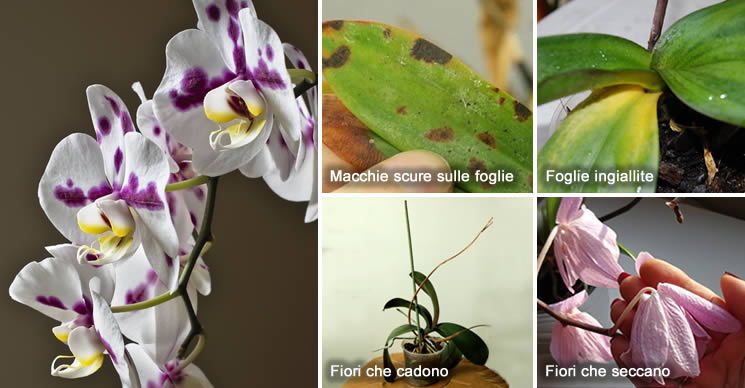
on All the Most Common Orchid Problems and How to Solve Them
Like all plants, orchids are also very susceptible to diseases or attacks by various pathogens. Bacteria, fungi and insects can attack our plants and weaken them.
However, if the right measures are taken, it is possible to minimize the risk. Excessive temperature or humidity, poor ventilation or inadequate care can prevent our orchids from blooming or, in some cases, even die.
Mushrooms
They are among the main threats to orchids, but they can be combated if detected early. In general, the presence of fungi is manifested by dark spots or spots on the leaves and flowers. They can also change the color of the flowers, making them yellow or darker.
Excess humidity, high temperatures and poor ventilation are the main causes of fungus. To get rid of fungus you can add about 4 grams of baking soda to a bottle of water equipped with a spray diffuser, mix well and spray on the plant.
Bacteria
These are pathogens that cause spots on the leaves, giving them a watery consistency and a dark color. Parts affected by viruses quickly die by decomposition.
Bacteria thrive when the environment around the plant is too humid and, unfortunately, there is no effective treatment. However, if we are detected early, we can remedy the problem by disinfecting the affected area with ground cinnamon, which has antibacterial properties.
Insects
The first threat to our orchids are aphids, which suck the sap of the plants, causing their death and malformations. Other insects that can attack orchids are scale insects (recognizable by their cottony consistency), mites and other insects.
To solve this problem, refer to the recipe for a natural insecticide based on alcohol and garlic . Alternatively, you can use a natural insecticide based on neem oil, which you can buy in specialty stores.
Here are some other common orchid problems and their solutions.
Lack of light
This problem prevents flowering. The stem weakens and the leaves become darker. The solution is to find a more suitable location, near a window but without direct sunlight.
Lack of humidity
The flowers no longer develop and the roots become whitish, while the leaves turn yellow and fall off. In this case, you need to apply more water, possibly using a bottle equipped with a spray diffuser.
Abnormal temperatures
Too much or too little heat can cause leaf drop. Correct the temperature by measuring it and, if necessary, changing the position of the plant.
Excess water
Roots rot and turn darker, while leaves turn yellow. Allow the soil to dry out between waterings.