
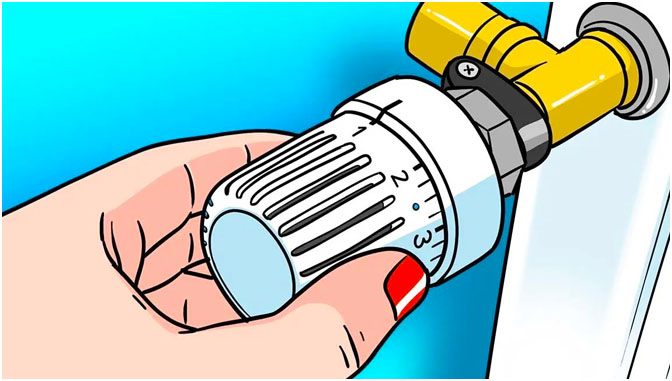
As you know, there are different heating levels, so it’s up to you to make the right choice. First and foremost, it’s important to understand the meaning of the numbers on your electric radiator’s thermostatic valve and identify the program best suited to your home. An optimal temperature will help you save some money.
What do the symbols on the radiator knob mean?
Thermostatic valves are extremely easy to use. Once attached to the radiator, simply turn the dial to select the temperature that provides the most comfort.
How do you unscrew the radiator valve to achieve a comfortable temperature in your home? The secret lies in correctly adjusting the dial, i.e., selecting the power output. In most cases, you’ll have six numbered programs available. These are tailored to each room.
You should use them as follows:
- 0 or the “snowflake icon” does not turn off the radiator completely. The radiator will maintain a temperature around 7°C: this setting is especially necessary if you are going away for a few days and it is very cold, so that your pipes do not freeze.
- Level 1 works well in laundry rooms or stairwells, heating up to 13°C.
- Level 2 is already around 16°C. It is particularly recommended during sleep.
- With level 3, you can reach a temperature of up to 20°C, which is the optimal value in most rooms of the house.
- Level 4 heats the air to 22-24°C. Use them, e.g., to heat the bathroom.
- Level 5 increases the temperature to 28°C: the room becomes too hot, so this program is not very useful.
- If the room is large enough, the comfortable temperature should be 19 to 20°C. Therefore, set your radiator to the “Sun” symbol.
- In night mode, set the dial to the moon icon to achieve a temperature of around 16 or 17°C.
Home Heating Savings Tips
The optimal temperature in your home should be between 18 and 22°C. This means that the reading on the thermostatic valve should not exceed level 4. In most cases, level 3 is sufficient. As a reminder, if you adjust your electric radiator correctly, you can save up to 20% of your energy.
For optimal comfort, the room you spend the most time in should ideally be heated to 19 or 20°C. When you sleep, you should lower the temperature to 16 or 17°C. And don’t forget to set the anti-freeze mode if you’re going to be away for several days.
Note: The thermostatic valve therefore acts like a small thermostat that is attached to each individual radiator, sensing the room temperature and regulating the unit’s performance by turning off or reducing the flow of hot water inside.
Good to know: The greater the temperature difference between the set temperature and the recorded temperature, the more the valve is open (up to maximum opening). But as this difference decreases, the valve will gradually close and reach the end of its shutdown (complete closure) once the temperature difference is zero. In this way, the radiator becomes independent of the rest of the system and can independently reduce the heat input until the desired temperature is reached. This is the moment when the water circulation stops and the radiator turns off.