
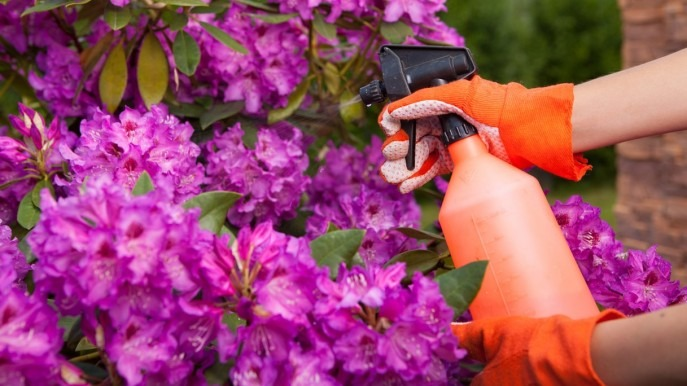
Looking for a natural pesticide for your plants? Here’s the baking soda trick and other highly effective recipes to try right away.
Anyone who has a flowery garden or balcony knows how difficult it is to eradicate pests: these small insects attack plants and consume their blood, often seriously damaging them or even causing their death. There are many types of pests, some very common—it’s practically impossible to have never encountered them—and others that are decidedly rarer. In any case, it’s necessary to resort to a remedy to protect plants from their devastating effects. How to do this? There are many chemical pesticides on the market, but it’s possible to try natural solutions first . Let’s discover the best.
Hint
Goodbye parasites: how to eradicate them
Natural pesticide with baking soda
All natural remedies for parasites
Goodbye parasites: how to eradicate them
From ants to rose lice, your garden is in constant danger. And if you only have a small balcony with a few seedlings here and there, you’re not safe anyway: pests really do arrive everywhere , causing serious damage to flowers and crops. It’s important to act quickly at the first signs, thus trying to prevent a real infestation. If, on the other hand, it’s too late, don’t waste any more time: you’ll need to find the pesticide best suited to your needs.
But are chemical insecticides the right choice? We’re talking about products that are effective against pests, but also highly polluting and often dangerous to health. Thinking about using them on fruits and vegetables, but also on your aromatic herbs that then end up in the kitchen, is not exactly the best. Better to try natural remedies , more environmentally friendly and often much cheaper, because they are prepared with ingredients available in all supermarkets. Here are some very effective ones.
Natural pesticide with baking soda
There are ingredients that we all have at home that have an incredibly powerful repellent effect against insects and parasites . One of them is sodium bicarbonate: a perfect ally for cleaning and for impeccable laundry, it is also useful for preparing a cheap and super effective DIY pesticide. Not to mention that it is harmless to plants and, above all, safe for humans. Let’s see the best ways to use it to protect your crops.
First, sprinkle baking soda all around your plants, both on the garden soil and on the balcony where you placed the flowerpots. This will keep earthworms, slugs, and ants away: for them, this common, usually harmless white powder is a real danger. For greater effectiveness against pest infestations, dissolve 3 tablespoons of baking soda in 4 liters of hot water and pour it into a spray bottle, spraying the mixture on the leaves and surrounding soil.
If you want an even more powerful remedy, excellent not only for fighting pests but also against fungal infections of plants, then fill a spray bottle with 1 liter of water, adding 4 tablespoons of baking soda and 60 ml of olive oil . Once everything is well mixed, spray the solution on the leaves and around the plant, avoiding the fruits and flowers. Even better if you do it early in the morning or in the evening after sunset, to prevent the water from evaporating immediately in the sun.
All natural remedies for parasites
Of course, the baking soda trick isn’t the only one you can use to get rid of pests. In the case of mealybugs or aphids, for example, a very effective remedy is Marseille soap . This product, even before being the best solution for household cleaning and laundry, is widely used in agriculture to protect plants from certain pests, particularly in the cultivation of aromatic herbs, vegetables and small fruit trees .
To prepare the pesticide, cut a block of Marseille soap into flakes and dissolve it in a saucepan filled with water, heating it over low heat until you get a homogeneous mixture. Let it cool and transfer it to a spray bottle, using it on the leaves and flowers you want to protect against pests. If you want to make it even more powerful, add a few drops of Neem oil , which contains an active ingredient excellent for repelling insects such as beetles and red spiders.
Another natural solution is propolis : this substance produced by bees contains large amounts of flavonoids, which stimulate the plant’s metabolism and strengthen its defenses. Preparing this pesticide is a little more complicated, but it’s definitely worth it because it’s highly effective and safe for both humans and the plants themselves. Start by preparing an aqueous solution : pour 150 g of propolis into 1 liter of water, adding 1 g of soy lecithin. Let it macerate for at least two weeks. Finally, pour the mixture through a careful filter. The residue will be used for the alcoholic solution.
The latter is prepared by pouring the residue into 1 liter of 95° ethyl alcohol , in this case also adding 1 g of soy lecithin. Leave to macerate for a few more weeks, stirring well at least once a day. At the end, filter the resulting mixture. The last step is to mix 100 g of aqueous solution with 100 g of alcoholic solution. Take 10 g of the mixture thus formed and dilute it in 5 liters of water : here is your pesticide to spray on plants in the garden or balcony, to fight against pests and fungi.
Then there are other macerates that are easier to prepare, but just as effective. The first is nettle macerate , which has a really unpleasant smell for insects (and is actually quite unpleasant for humans too). Harvest 1 kg of nettles without roots and put them to macerate in 10 liters of water for at least a few days. Filter the resulting solution and pour it into a spray bottle: the insecticide is ready, you just have to spray it on the plants without needing to dilute it further. The extra idea? Let the nettles soak for a few weeks, and you will also have an excellent fertilizer .
Finally, let’s see how to prepare garlic macerate : this bulb, which certainly gives off a not-so-pleasant odor, contains large amounts of allicin, an antibiotic substance with strong antiparasitic properties. Crush 75g of garlic and put it all in a container containing 10 liters of hot water. You will need to let the mixture macerate for at least 5 hours, before filtering it and transferring it to a spray bottle . Spray the garlic macerate on the plants without diluting it, preferably early in the morning or evening.