
on How to Water Orchids: The Milk Trick is Brilliant
Delicate and wonderful: orchids need very careful care. And yes, there is a special nutrient that can help you.
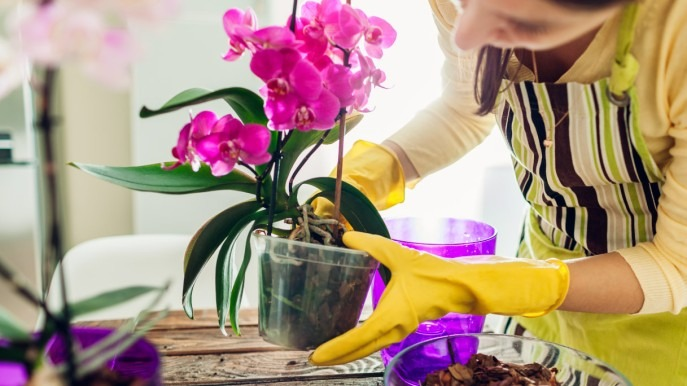
Too much water or too little? Watering orchids can be a dilemma. It’s essential to know how to proceed, not only to ensure consistent flowering , but also to keep the plant healthy . There are also tips that can help with care, which must be done correctly to preserve the delicate appearance of the vase. Let’s discover together how to have beautiful flowers with little effort.
Hint
How to give milk to orchids
How to water properly
What water to use?
How to spray leaves
How to adapt irrigation to the soil
Fertilizer and flowering
How to give milk to orchids
Milk, yes. You read that right. This very special ingredient helps you clean the orchid leaves , so it works in addition to irrigation . Preparing the right solution for this operation is very simple. Just mix a spoonful of water with one of milk and apply gently to the sheets and using a cotton ball or makeup remover pad. It can be used to remove dust, which often hides at the ends of the plant, as well as to remove limescale residue , the result of water drops left to evaporate and not dried beforehand with a soft cloth.
Indeed, excess water can also cause problems for the leaves and promote the proliferation of fungal infections. Milk also helps eliminate spores that can compromise – even quickly – the health of the plant. Milk helps clean the leaf , making it healthy but also shining. Even the eye wants it, you might think, and this is also the case with orchids. White, colorful, spotted: having flowers every year is certainly the goal of those who love orchids and, for this reason, take care of them.
How to water properly
Let’s return to the main menu, the one where the correct watering of your orchids appears – at the top of the list. It’s not easy, of course, especially since they don’t grow in traditional potting soil and therefore we can’t predict how the water will behave. For them, a mixture of peat, bark, and other inert materials is indeed necessary. The goal of irrigation is therefore to restore moisture to the peat and bark, which retain it with relative ease.
First precaution: orchids are not watered from above. You must gently immerse a vase in a sink or a basin filled with water. The liquid level should not exceed half of the pot . Be very careful not to let the bark come out . The immersion should not be too short but nor too long: the peat must indeed be impregnated but stagnant water must be avoided. 20 minutes may be enough, but before putting the pot back in its saucer, let it drain well, even half an hour.
Water needs vary with the seasons and, above all, with changing temperatures . Once a week may be enough in spring, while in summer you should repeat the operation – at least two or three times – depending on the heat. Return to once a week in autumn and every 10 days in winter. Keep in mind that your orchid is giving us signs of lack of water . The substrate should not be dry, while the roots should be green . If they tend towards silver, then they are thirsty.
What water to use?
To water the orchid correctly, it is important to choose the right water . As you will have understood, this plant does not like limestone. And no, not even chlorine . The use of mains water is therefore not recommended; it is rather advisable to use rainwater or demineralized water, the same one used to fill the iron’s boiler.
The same water can be used to gently mist the leaves , or alternatively you can fill a watering can and let the tap water settle so that the limescale settles at the bottom. Pay careful attention to the water temperature , which should not be too cold. At 15°C, in fact, the orchid begins to lose its flowers. Try to use it at room temperature. In winter, you can dilute it for a few seconds by putting it in the microwave .
How to spray leaves
For orchids, it is important that the environment they live in is humid. Our homes, on the other hand, have dry air , especially when they are heated or cooled by heating and air conditioning systems. Therefore, it is necessary to recreate the optimal environment for them, through proper misting of the leaves. This operation can be done all year round, but be careful with the flowers, which should not receive traces of liquid.
If the environment is really very dry, then you can try a room humidifier . Unlike other houseplants, it is best to spray the leaves early in the morning. The heat of the sun is indeed able to evaporate the excess water in the leaves, so as to prevent the appearance of spores .
How to adapt irrigation to the soil
Proper watering of your orchid depends a lot on the potting soil you use . If it is made of bark and sphagnum, then you can also try traditional watering , provided you let the pot drain before placing it on its saucer. If growing only in bark , you can then water from below using the methods we have suggested. The leaves can be gently moistened using a spray bottle , remembering to dry off excess water.
Fertilizer and flowering
The orchid is a plant that requires care in many ways. In fact, fertilizer is essential for its proper growth and to obtain abundant and long-lasting flowering. It is therefore very important to choose the right one, among the many proposals, which differ not only in the formulation – not all are suitable for all varieties of Orchidaceae – and in the administration . The indications must be indicated on the label , otherwise you can ask your trusted dealer for advice. The plant must be fertilized all year round.
Flowering is expected twice a year, once in spring and once in autumn. This phase lasts several months, so you can count on a scenographic installation for a while. Remember that the flowers should never be wet. Once the last flower has fallen , you can decide whether to keep the stems or cut them. In the first case, the flowers will bloom again on the same stems, but they will be smaller. If, on the other hand, you choose to remove them, the plant will focus on producing new stems, on which the offspring of the new season will be born.