
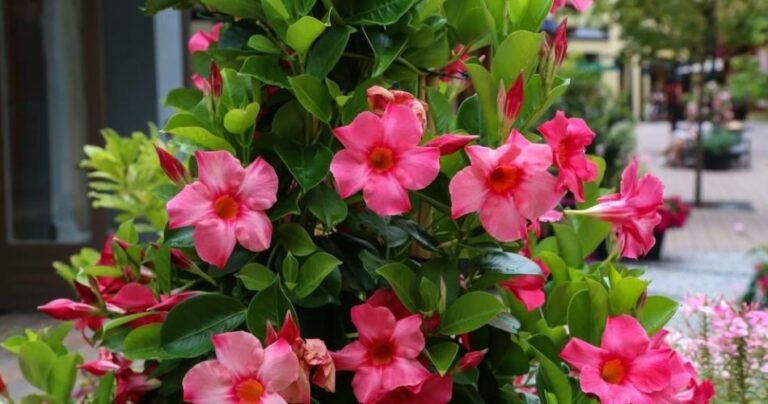
Find a bright spot for it, water it often in summer, and prune it in autumn. Three simple tips for caring for your dipladenia, a climbing plant native to Central America that can also be grown on your balcony.
Gaia Cortese•March 17, 2021
GREEN
NATURE
PLANTS AND GARDENING
Recognizable by its bell-shaped flowers in shades of white, pink and red, dipladenia is an ornamental plant belonging to the Apocynaceae family and native to Central American countries. It is a climbing plant , used to embellish terraces and balconies, pergolas and gardens. There are nearly two hundred varieties of dipladenia , or mandevilla , some of them are more suitable for indoor cultivation such as dipladenia rosea , while others are more suitable for outdoor cultivation such as dipladenia williamsii .
In any case , the maintenance of this plant is very simple , provided that it is watered regularly during the hottest season, guaranteeing it a bright position and mild temperatures.
How to grow dipladenia
- Characteristics of the plant
- Climate and location
- Soil and fertilization
- When to water it
- Flowering
- Size
- Disorders and illnesses
Plant characteristics
Dipladenia stands out not only for its bell-shaped and generously sized flowers (up to 5 cm in diameter), but also for its intense glossy green leaves , which do not go unnoticed. Given its origin, it is not surprising that this plant is a true tropical vine adorned with magnificent flowers and which, with the right support, can beautify a corner of the garden or a terrace of the house.
Climate and location
Dipladenia appreciates the mild climate and does not tolerate temperatures that are too low or too high. The ideal temperature for growth is around 21°C, so in summer it should be protected in the shade if the climate tends to be scorching hot. During the winter months, however, the dipladenia should be kept at a temperature between 10 and 14°C, illuminated by natural light, in a place protected from the cold. The best place to place this plant is in a bright area , both inside and outside the house, depending on the seasons and temperatures.
Soil and fertilization
The ideal soil for the proper development of this climbing plant is a mixture of garden soil, peat, sand and leaves . The important thing is that the soil is rich in organic substances, otherwise you can add humus or fertilize in spring and summer.
When to water it
Dipladenia needs frequent watering, especially in summer. Allow the soil to dry out between waterings, without over-watering the plant, which easily tolerates short periods of drought. To ensure moisture, you can place damp gravel in the saucer and spray the leaves with water in the late evening.
Bloom
The Dipladenia blooms in late spring , and the good news is that the flowers continue to bloom until autumn. Be sure to place the plant in a cool spot during the winter to enjoy abundant blooms in the summer.
Size
Dipladenia should be pruned in the fall , when it is in full dormancy. Pruning the plant helps promote lateral growth of branches, leaves and flowers, as well as giving the desired shape to the plant itself.
Disorders and diseases
If you notice that the leaves of your dipladenia are beginning to turn yellow and are covered with small dark dots, this could mean that it has been attacked by the red spider mite , a mite that can also become harmful if you do not intervene quickly with a specific product. Another intervention you can do is to increase the humidity of the plant since it is precisely the dry air that favors the proliferation of this mite.
If you notice whitish spots instead , the attack probably comes from the cottony scale insect , which you can remove with a cotton ball soaked in denatured alcohol or with a specific insecticide if the infestation is already extensive.
If brown spots appear, perhaps the plant has been underwatered or has been exposed to direct sunlight. Also pay attention to drooping leaves : if this happens during the coldest season, it could be a temperature problem (too low), so move the plant to a more sheltered location.