
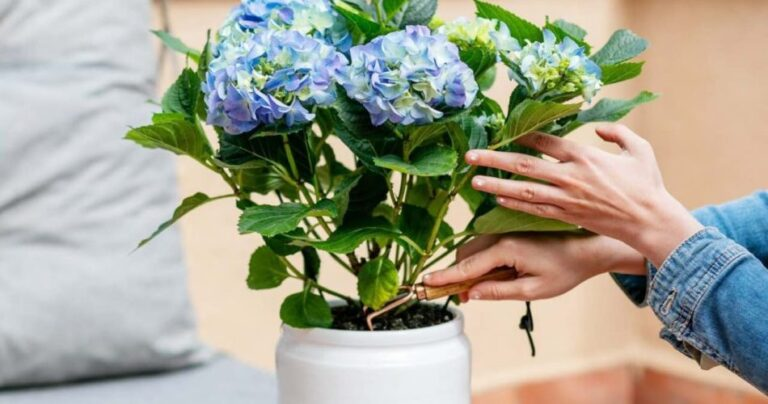
Are you curious to know how to propagate hydrangeas in a few simple steps? Let’s discover the twig technique. Hydrangeas are one of the most commonly grown plants in the garden or on the patio. Their colors, in fact, bring the environment to life and give it a graceful appearance. These beautiful flowers can decorate and beautify the space around your home.
The shape and bright colors of these flowers are loved by everyone and are able to give a truly lush and intense look to your garden or balcony.
Like all plants, hydrangeas also have specific meanings . In the language of flowers, in fact, they symbolize love and great friendship. Giving hydrangeas therefore testifies to a strong affection that exists between two people, both in reference to unique love and in relation to a rare friendship.
In this article, we’ll look at how to have a garden “overrun” with hydrangeas. Want to get fresh buds without breaking the bank? Here’s the perfect technique for multiplying your hydrangeas quickly , safely, and efficiently.
More Hydrangeas in the Garden Thanks to a Truly Brilliant Method
Bright colors are the staple of hydrangeas. Indeed, it’s possible to obtain purple, fuchsia, red, indigo, lilac, blue, and many other colors. All these colors enhance your garden and make it, as mentioned, particularly vibrant.
Hydrangeas
To ensure a rich presence of hydrangeas in the garden and a wide flowering period, it is advisable to take the right precautions. The first thing to do is certainly to choose the ideal soil for this type of flowering plant. It must be composed of peat and it is essential that it be particularly fresh and acidic.
Unlike many other plants, hydrangeas do not mind a relatively humid environment and also like cool temperatures. Hydrangeas also do not like to “spend their days” in the blazing sun.
For these flowers, it will therefore be important to choose a location with little sun exposure or shade. During the watering phase, it will then be essential to opt for demineralized water or, in any case, water with a low lime content.
So what should you know about the twig technique ? Let’s discover how to grow a large number of hydrangeas in a few simple steps. A completely natural and cost-free propagation method. Here are all the details.
The twig technique
We’ve mentioned the soil to use for growing hydrangeas. In addition to peat, soil with perlite and sand can also be added to the vase.
Creating the right mix of fertile soil is essential for your hydrangeas to thrive. Then, with the help of a sprig, you can achieve incredible multiplication of this flower . A simple and truly effective method. Let’s see the correct procedure.
Cultivated hydrangeas
It is advisable to detach a part of a plant with one or more buds, that is to say a cutting . It must measure at least 10 centimeters long and have a node at the base. This cutting must not have large leaves. In addition, the small ones must be present only at the top and in small quantities.
You will need to water the substrate so that the soil is sufficiently moist. At this point, you can insert the stem to a depth of at least 3 centimeters. You will first need to place a special gel rooting agent at the base of the cuttings.
After a few weeks, you will see how your hydrangeas have already multiplied the flowers present . A multiplication that can be achieved by means of a simple twig, since this flower propagates perfectly thanks to the cutting taken from the shoots placed above.