
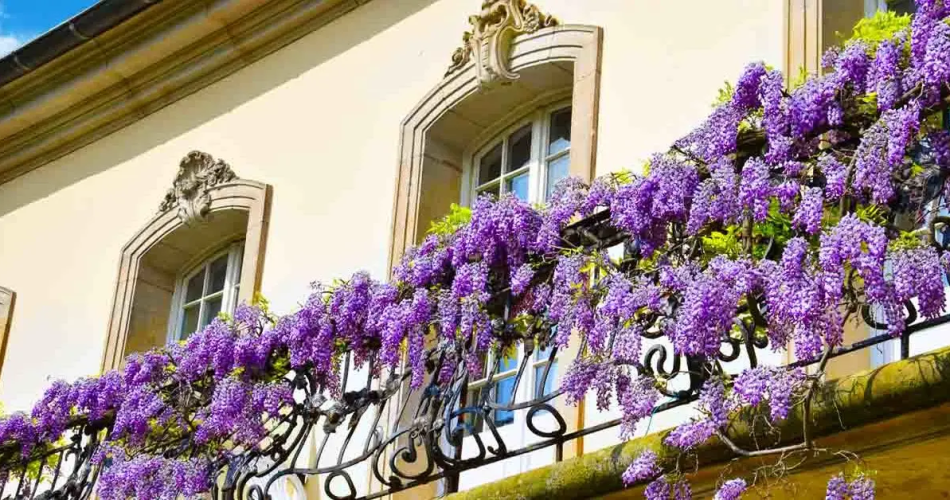
On a balcony that receives sun all afternoon, and therefore faces west, many plant varieties can flourish throughout the summer. From verbena to dahlias, from the dangling flowers of wisteria to a shrub like viburnum, discover 5 plants that thrive on this type of balcony.
It’s important to know that on a west-facing terrace or balcony, the sun’s rays arrive in the second half of the day, that is, from around 2 p.m. until sunset. This is an area that can be considered sunny: this is why all plants that require light exposure have the “green light” on a west-facing balcony.
Among the most suitable plants are dahlias and petunias, but also wisteria, which, with its drooping purple flowers, can beautify the railings of any balcony. Also choose verbena or viburnum, which will guarantee abundant flowering throughout the summer and into late autumn.
Read also: 27 mosquito and fly repellent plants to have at home in 2023
The 5 plants to grow on a west-facing balcony
Verbena
verbena
Widespread in Europe, although more native to America, this plant belongs to the Verbenaceae family. Its unique feature? The verbena flower can vary from white to pink and from bright red to purple. It blooms from early summer to late autumn.
This plant should be grown in a bright, sunny, and wind-protected location. If grown in a pot, ensure that its clay soil is constantly moist and fresh, but avoid waterlogging in the saucer. Verbena does not tolerate siliceous or calcareous soils.
This aromatic plant with delicate flowers is one of the ultimate anti-stress medicinal plants. This is particularly true for its sedative, anti-neuralgic, and relaxing properties, which immediately provide a feeling of calm. It acts on the nervous system and banishes all forms of anxiety or depression. But that’s not all. In herbal tea, its virtues are countless: verbena aids digestion, relieves spasms, fights fever, and many other ailments.
Dahlia
dahlia
Native to Mexico, the dahlia is a very beautiful ornamental plant. Its flowers have a very special charm, ranging from very bright colors to softer tones, ranging from yellow to red, including white and pink.
Its flowering is guaranteed all summer long until late autumn, provided the plant is exposed to the sun for a good part of the day. It also provides that the balcony faces west and generally receives sunlight throughout the afternoon. Planting should be done in spring, approximately between late March and May, when temperatures really start to be milder than in winter. If you grow it in a pot, make sure it has a diameter of at least 30 centimeters to allow room for the plant and its roots. It prefers to be planted in clayey, well-fertilized soil. As long as it is watered regularly and receives sufficient sunlight, it will bloom royally.
Additionally, this flower bulb is highly prized by Mexicans for its diuretic properties. Dahlia is often used to relieve colic and intestinal disorders, and to treat certain skin problems such as boils. It is also effective against insect bites and soothes throat problems.
Petunia
petunia
A botanical must-have, the petunia is a plant that thrives on a west-facing balcony. Native to South America, it’s a perennial herbaceous plant with a creeping habit that offers abundant blooms and bright shades, ranging from purple to pink to white.
Petunias need at least six hours of direct sunlight a day, a condition that a west-facing balcony can provide. Otherwise, flowering may be poor. Protect it well from the wind and, at the first sign of cold weather, bring it indoors. When the weather warms up, you can take it outside, but only if the temperature averages around 15°C.
Viburnum
viburnum
Also known as the “Snowball,” the viburnum is a shrub of the Caprifoliaceae family that is also grown for ornamental purposes in pots: this is why it will look great on a west-facing balcony. Generally, depending on the variety, viburnum flowers can be white or red and appear from spring to late autumn.
Make sure the soil is moist, rich in humus, and has good drainage. Water regularly, especially in the first year after planting.
Antispasmodic and astringent, viburnum has numerous medicinal and therapeutic properties, particularly in gynecology. Indeed, its bark treats various ailments such as heavy and painful periods, morning sickness during pregnancy, uterine prolapse and also relieves certain symptoms of menopause, such as hot flashes.
Also read: 20 indoor plants ideal for poorly lit rooms
Glycine
wisteria
Among the ideal plants for a west-facing terrace, we also find wisteria, a climbing plant suitable for covering pergolas and arches, but also for adding color to your balcony railings. Its purple clusters make a splash in the environment. Resistant and vigorous, wisteria is not very demanding: it should be planted between October and March in non-calcareous and dry soil, but drained and fertilized with a fertilizer rich in nitrogen, potassium, and phosphorus. To see its beautiful clusters of drooping lilac flowers, you will have to wait for the first flowering between May and June and the second, less abundant, in August.
In seed form or as a dietary supplement, glycine is an anti-inflammatory amino acid that offers numerous benefits for the body: highly valued by athletes, it promotes recovery, accelerates skin healing, stimulates circulation, promotes sleep, and detoxifies the liver. In addition, it fights cellular aging by hydrating the epidermis and regenerating skin tissue.
Also read: 14 air-purifying indoor plants ideal for children’s bedrooms