
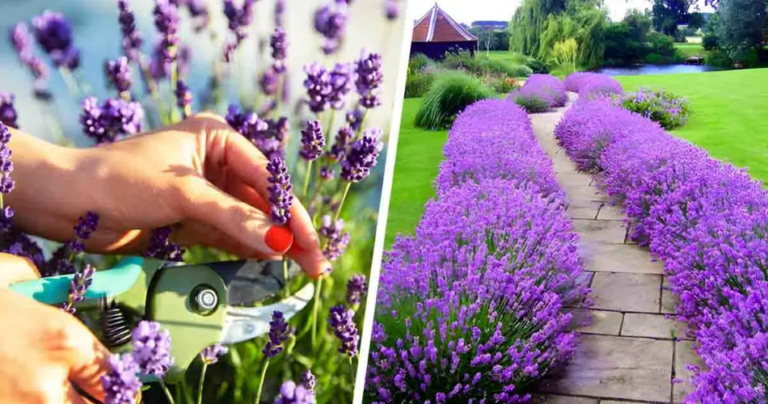
on 7 tips for planting a lavender hedge in your garden
There’s nothing like a garden hedge to define your property and protect you from your neighbors. Whether it’s a flowering hedge or a greenery arrangement, this plant arrangement brings a wonderfully colorful space to your garden. For a flowering hedge, lavender is the ideal choice. They are easy to grow and fill your entire garden with their fragrant flowers.
Here are seven conditions for properly planting and maintaining a lavender hedge in your garden.
What are the 7 conditions for having a beautiful lavender hedge in your garden?
For a beautiful garden border, lavender is the fragrant plant to choose. Here’s how to care for it.
Also read: 8 tips for making an orchid bloom again every year
1- Lavender, an ideal plant for creating a beautiful flowering hedge
lavender
Lavender is a hardy plant that doesn’t require much maintenance. These small shrubs are known for their purple flowers and summer fragrance. Depending on the species, lavender blooms in a variety of colors, from white to pink, blue, or purple. A lavender hedge can be used to define a path with beautiful, fragrant flower borders. Lavender should be watered at the beginning of its planting, and then it thrives without watering. It grows even better in dry periods.
2- Plant lavender well to create a flowering hedge
lavender1
To plant lavender, all you need is dry soil and a sunny location. Lavender plants need six hours of sun exposure per day to thrive. They bloom best in hot, dry climates and don’t require much water. These flowering plants thrive in well-drained soil with gravel.
3- Choose the right location for a harmonious lavender hedge
To create a beautiful lavender hedge, plant lavender plants about 30 to 40 centimeters apart. Lavender tends to take up a lot of space, so this is important for the plant’s proper growth. Dig a hole large enough for planting. Place the lavender plant in the center of the hole with the top of the root ball slightly lower than the soil level. Work the soil around the plant and firm it down regularly with your feet or hands. Once your plants are established, water them to moisten the soil. Do not overwater, as overwatering could distort the rounded shape of your lavender plants.
4- Trim a lavender hedge
lavender2
Every year, at the end of flowering, it’s important to prune your lavender plants. To do this, remove two-thirds of the young shoots and structure your flowering hedge. Cut the faded stems as close to their roots as possible and cut the branches back by half their length to encourage the growth of new flowers.
5- To grow the lavender hedge, good air circulation is necessary
To grow lavender as a flowering hedge, adequate air circulation is necessary to prevent disease. For this reason, it is important to space lavender plants well when planting. This spacing will allow each lavender plant to receive sufficient airflow, and the roots will be less likely to rot.
6- Your hedge must respect the planting distances
A hedge up to 2 meters high can be planted 50 centimeters from your neighbors. If it exceeds 2 meters in height, it must be located within 2 meters of the neighbor’s property line. If you have decided to create a dividing hedge, you must agree with your neighbor to be able to plant on the dividing line between your two houses.
Also read : 5 reasons to use bicarbonate on plants
7- Limit the maintenance of your lavender hedge by using mulch
To avoid maintaining your lavender hedge, you can mulch it. This technique prevents moisture from evaporating from the soil surface. To do this, cover your soil with a layer of mulch at least 10 centimeters thick. Mulching limits the proliferation of weeds and insect invasions.
With these tips, you now know how to plant a lavender hedge in your garden. This perennial plant can last up to 15 years if properly maintained.
Also read: What’s the secret to lush, beautiful geraniums? Simply season them with this ingredient