
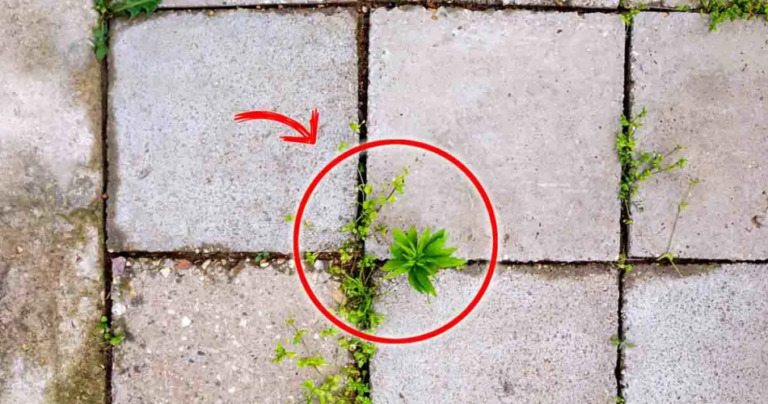
on The easiest and cheapest way to get rid of weeds
Nothing ruins a yard or garden like weeds that invade walkways and sometimes kill your plants. That’s why it’s so important to get rid of them without necessarily using herbicides that are harmful to your health and the environment. To this end, we offer weed control methods that are environmentally friendly and do not use chemical herbicides.
You don’t need chemical herbicides to eliminate the weeds infesting your yard or garden. Here are some simple and cost-effective techniques to achieve this goal.
weeds
Simple and economical methods to permanently eliminate weeds
By choosing the right natural herbicides, you’ll definitely be satisfied with their effectiveness against weeds. Here’s a list of everything you can try.
Read also: H how to make a natural weedkiller with baking soda and vinegar?
– Dishwashing detergent, salt and vinegar against weeds
With this measure, the white vinegar will absorb moisture thanks to its acetic acid content, while the dish detergent will act as an absorbent. Depending on your soil, pour the mixture into a spray bottle and spray it directly onto the weeds. Do this preferably during sunny hours of the day.
Normally, you should see unwanted weeds turn brown after a few hours. If necessary, spray more of your natural weed killer to prevent weeds from growing back.
– Baking soda to fight weeds
Baking soda is one of the best eco-friendly weed killers for weeding your driveway. To use this versatile product for this purpose, sprinkle baking soda on weeds while avoiding lawns and other plants.
weed spraying
– Mulch to eliminate weeds
Mulching is an excellent solution for controlling weeds growing in your garden or walkways. Using a thick layer of bark mulch helps suppress perennial weeds by smothering them. Mulch prevents sunlight from penetrating the soil surface. Place it among your crops and other plants.
– Boil water to kill weeds
A superb organic weed killer, boiling water is a quick and easy way to kill unwanted plants. Be sure to use it on weeds that aren’t near the plants you need to protect.
To eliminate weeds using this method, boil water and then pour it over the affected areas. Also, be sure to hold the spout of the container close to the root of the weed . You should notice that it gradually disappears before dying. To prevent possible regrowth, you can repeat the application.
– Newspaper to smother weeds
To take advantage of this technique, place three or more layers of damp newspaper over the weeds. If you’re interested in planting beds in your yard or garden, you can always cover the newspaper exposure with a layer of mulch or gravel.
– Manual weeding to eliminate weeds
Hand weeding remains one of the most effective methods for removing weeds. However, while it is relatively easy to remove weeds from small areas of cultivated vegetables and flowers, it is less so for larger areas. In this case, you should use a hoe . To remove weeds between rows of vegetables, it is always best to use a stirrup hoe.
– Salt to kill weeds
To use salt as a weedkiller, start by spreading it on the weeds near the tiles. This prevents these weeds from replenishing more water, which will lead to their elimination . However, since salt inhibits plant regrowth, it is best to water it at least 50 cm away from other plants.
Read also: Powerful weedkiller: 11 tips for eliminating weeds
salt spill on the driveway
– Vegetable cooking water to eliminate weeds
Thanks to the nutrients released by the vegetables and the salt in the cooking water, it can be used entirely to eliminate weeds that nest between tiles and stone slabs. Pour the water over the affected areas, then wait a few days for them to disappear.
– White vinegar, a natural herbicide to fight weeds
To prevent unwanted new weeds from sprouting, dilute white vinegar alone with equal parts water, then place the solution in a spray bottle before spraying it on the affected areas. This gradually dries out the harmful weeds thanks to the acetic acid content of the vinegar. You can also spray the solution between the tile joints once a week to prevent regrowth. Of course, be sure to target only the weeds so as not to damage your plants.
Read also: 5 herbicide recipes to make with white vinegar