
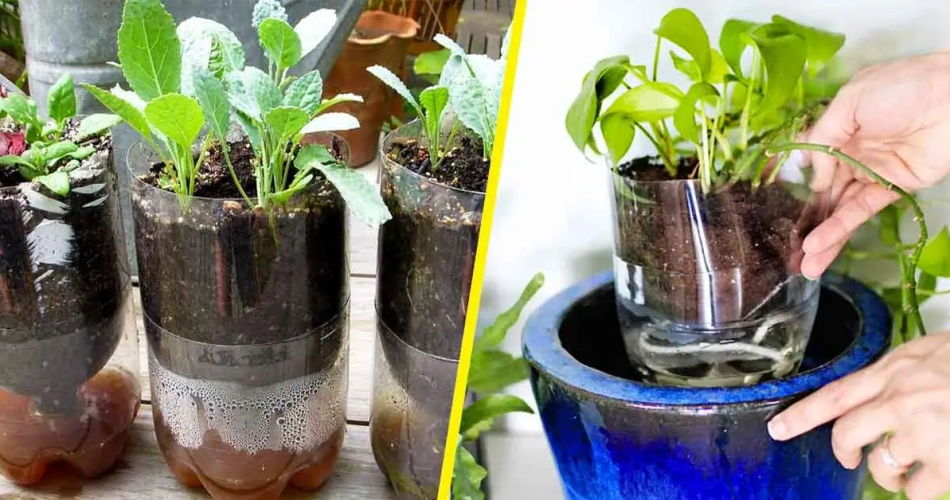
When we have a garden or indoor plants, it’s difficult to stay away from them for long. Some plants love humidity and need to be watered regularly. Without watering, they can dry out and wilt, especially in hot weather. To stop worrying about watering, why not make self-watering pots? We’ll tell you more in this article.
Plants need regular watering, otherwise they will wilt. To ensure your plants, especially your seedlings, never lack water, you can create self-watering pots.
How to make a self-watering pot from a plastic bottle for your seedlings and plants?
Take a clean, dry plastic bottle and cut it off 2/3 of the base using a sharp knife. Both bases will be used to make a self-watering pot.
Also read: Which plants should not be fertilized with ashes in the garden?
Cut a plastic bottle
Unscrew the cap and pierce a hole in the center. Take a piece of string the same size as the bottle, fold it in half, and thread it through the hole. Tie the end inside the cap and screw the cap back on. Fill the bottom of the bottle with water, then turn the top of the bottle upside down, cap it , and insert it into the bottom. Make sure the string is submerged in water. Fill the top of the bottle with potting soil and plant your seeds. With this trick, you’ll quickly get young seedlings. The plastic bottle helps retain heat , just like a greenhouse. As for the string, it keeps the soil constantly moist. Your plants will be able to grow without suffering from drought, even if it’s hot.
Self-watering pot
You can transplant your plants into the ground or into a pot, provided they reach about 10 cm in height. The season must also be right for sowing.
Additionally, self-watering pots aren’t suitable for all plants. In fact, those that don’t like having their roots constantly wet may suffer from excess moisture. This is also the case for succulents, which have limited water requirements. These succulents have the ability to store water thanks to their fleshy tissues. They can survive in dry and arid climates. On the other hand, plants that require frequent watering, such as geraniums and roses, will do well in a self-watering pot.
To keep your plants hydrated even when you’re away, you might consider another solution: creating an automatic irrigation system that allows drip irrigation from a plastic bottle.
How to set up drip irrigation from a plastic bottle for your plants?
Take a 1.5L plastic bottle for potted plants or a 5L plastic bottle for your garden or vegetable seedlings. Unscrew the cap and pierce it in the center. Then fill the bottle with water and replace the cap. Simply turn it upside down and push the neck into the soil. This drip irrigation system should be installed a few days before departure. This will allow you to control the water flow and adjust the hole opening if necessary. In addition, this drip irrigation, also called micro-irrigation, is an economical irrigation system.
What are the tips for successfully watering plants?
When you have a garden or simply indoor green plants, it’s important to pay attention to the plants’ foliage. The condition of the leaves allows you to know if the plant is overwatered or underwatered. Too much water can be fatal to your plant. Its leaves soften and turn yellow. In addition, the roots suffocate and rot. Not to mention that excess moisture encourages insect and pest attacks. Hence the importance of removing stagnant water from the saucer or vase after each watering.
In cases of water stress, plant foliage may turn yellow. Leaves may fall off and curl up, depending on the variety.
Water the plants
It is also advisable to adjust watering according to the plant’s needs and the seasons. Plants need less water in winter than in summer. To determine if you need to water your plant, check the substrate; if it feels dry to the touch, the plant needs water.
Read also: How often should you water houseplants to keep them healthy?
Finally, always water your plant with room-temperature water, preferably non-calcareous water, such as rainwater. Very cold or very hot water can cause thermal shock to the plant and damage its root system.
With these simple tips, your plants will never be dehydrated!
Read also: 14 air-purifying indoor plants ideal for children’s rooms