
The gardener’s tip for automatically watering your plants while on vacation
Are you moving soon or planning to go on vacation soon? So, you can’t water your plants as usual. There’s no need to disturb your neighbor or family member. There are always simple and ingenious ways to solve this problem and ensure the survival of your beloved plants. So you can travel with complete peace of mind!
Naturally, regardless of the species, watering plants is essential for optimal development at every stage of their growth. However, as a general rule, if they receive too much water, they can suffer damage to their roots, stems, and leaves. Conversely, if they don’t receive enough, they risk drying out and dying in a short time.
Here are some ingenious techniques for watering your plants without wasting water or spending too much money. Thanks to these solutions, for several days, you won’t need to manually water your potted or in-ground plants, including your vegetable garden. This will allow you to go on vacation or a weekend away without worry and without asking your loved ones for help.
Read also: How to clean a dishwasher with white vinegar and baking soda?
How does this trick work?
At first glance, this solution may seem laborious, but rest assured, in less than 5 minutes you can prepare each sprinkler. The first step is to obtain plastic bottles of two different sizes: you can combine half-liter bottles and 1.5-liter bottles, or 1.5-liter bottles and 3-liter bottles. Note that the larger the containers, the longer the water charge will last. Depending on your needs, obtain plastic containers of different sizes and follow the instructions to have your irrigation system at zero cost and with zero environmental impact.
The advantages of this irrigation system
irrigation system
As you know, the warmer the temperatures, the more plants need to be watered. When the warmer weather arrives, you’ll love this fully automatic system, which is very practical and free. Each drop falls directly onto the soil without being sprayed onto the pots, but always ends up a few centimeters from the roots. As a bonus, you can recycle plastic bottles, pots, and jars.
The filter mat
If you have a lot of potted houseplants, you can use an even simpler method. Simply place a small cloth under the plants on a flat surface. Part of the cloth should be submerged in a container filled with water, which should be placed at a lower level than the plants. This will allow the water to rise into the soil and thus water the plants.
The communicating siphon
Another very effective method for watering your plants is the communicating siphon. You will only need a bottle if there is only one plant to water, or a larger container if there are several, and long strips of filter fabric or woven wool. One end of the strips should be positioned at the bottom of the bucket or bottle and the other end 2 or 3 cm below the soil, moistening each strip well before inserting it. The water reservoir should always be placed a little higher than the pots.
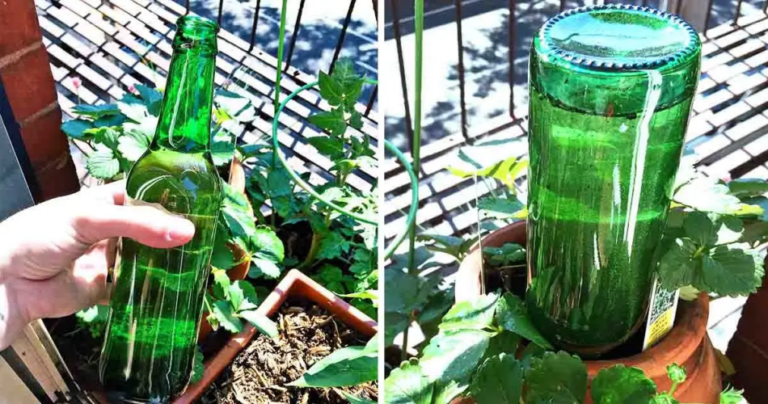
The upside-down bottle
upside down bottle
Before going on vacation, this tip will be easy to adopt: just fill a few plastic water bottles.
If your plant is small, you can use half-liter bottles or one-liter bottles if it is larger.
After filling the bottle with water, poke small holes in the cap and place it back in the pot with the cap pressed into the soil. This will allow the water to drain out little by little without over-wetting the soil.
Read also: 20 tips for humidifying the air in your home
Make holes in the soil and immerse the plant in a basin
When the soil becomes very dry, it must be rehydrated very carefully. Rapid and abundant watering will only create stagnant water at the bottom, and the plant will not be able to be completely wet. To remedy this situation: make a hole in the soil, being careful not to damage the roots, and place the plant with its pot in a basin of water. After about an hour, the plant will be rehydrated again.
Cut off the dry parts and spray the green parts
spray the plants
After removing the plant from the bowl, wring out the excess water. It is also important to trim off any dry parts. Dead leaves, branches, and holes should be removed so the plant can fully regenerate . Remember to spray the green leaves with distilled water or rainwater. Then, avoid placing the shrub in a location that is too sunny. It is best to place it in a cool, shady spot and wait for it to grow back.