
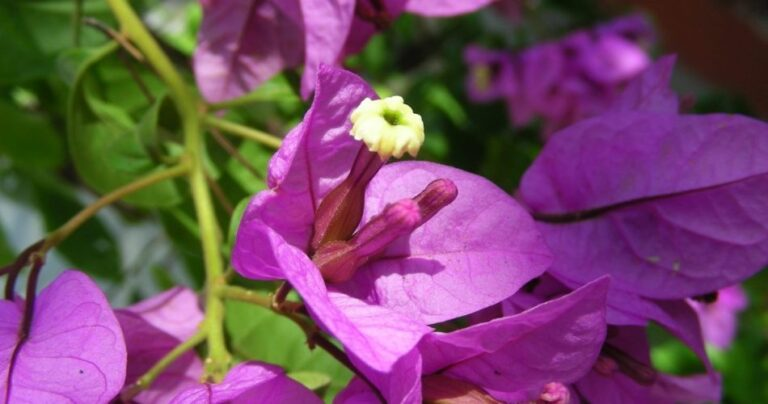
Native to South America, bougainvillea also grows in our country, generally in coastal areas and in the South. You can also grow this plant on your balcony, protecting it from the cold and frost of winter. In fact, this plant with its vibrant flowers can also be grown in pots: find out when it blooms and how to train it to climb a support.
Gaia Cortese • July 26, 2021
BACK
NATURE
PLANTS AND GARDENING
Bougainvillea, also called bougainvillea or bougainvillea , is a beautiful climbing plant that you can use to cover fence walls or to form a magnificent flowering hedge , but the good news is that you can also grow it in a pot and keep it on the balcony . Its name was chosen in 1768, in honor of the French explorer and admiral Louis Antoine de Bougainville , who discovered this plant belonging to the Nyctaginaceae family in Brazil.
It is an evergreen plant that blooms offering the most vivid colors , from pink to fuchsia , from magenta to purple , up to red and orange . There are more than 300 varieties , many of which have been obtained by hybridization or spontaneous mutations. Coming from South America, you can imagine that the bougainvillea is a plant that feels comfortable in the sun, in a rather warm climate: for this reason, in winter it will be necessary to take more care of it to make it survive the low temperatures and you can do it with I will give you some tips .
Bougainvillea
- Variety and species
2.Culture and care - The expert’s opinion
Varieties and species
The name bougainvillea indicates a genus of flowering plants belonging to the Nyctaginaceae family and native to South America and the tropical and subtropical areas of Brazil. Today, you hear more about bougainvillea , the term generally used to refer to this plant, although to be precise, there are 18 species and hundreds of different varieties . Let’s try to see some of them:
Bougainvillea glabra : This species is native to Brazil and can reach a considerable height, up to about 10 meters. Its colors vary from red to purple and its appearance is particularly lush, with very bright leaves.
Bougainvillea aurantiaca : This is one of the least known species, also because it requires very warm temperatures to grow and does not tolerate sudden temperature changes. Its leaves are ochre yellow in color.
Bougainvillea x buttiana : the result of a cross between Bougainvillea glabra and Bougainvillea peruviana , this hybrid species is characterized by colors that can be very different from each other depending on the variety.
Bougainvillea spectabilis : another species of Brazilian origin, it has bracts (i.e. the leaves that accompany the flowers) colored an intense pink.
Bouiganvillea speciosa : the bracts of this species, also native to Brazil, have a color between pink and fuchsia and have a particular shape that resembles a heart .
Bougainvillea refulgens : in this species, yet another of Brazilian origin, the bracts are gathered in hanging panicles with purplish tones that create a splendid spectacle.
Within the same species of bougainvillea you can find plants with slightly different characteristics: to give you an example, the Bougainvillea glabra is distinguished in the Variegata variety with red flowers with white streaks, in the Crimson Lake characterized by carmine red flowers and in the Sanderiana . with purple inflorescences.
Culture and care
As I was telling you, the climbing habit of the bougainvillea makes it an ideal plant for climbing pergolas or creating hedges, but there are some varieties , especially shrubs, that are also suitable for growing in pots , making them perfect for adding a touch of color to your balcony. Let’s see the most important tips for caring for these plants.
When to plant it
Bougainvillea can be grown from seeds , by transplanting the plant or by cutting, that is to say , through a small twig of about ten centimeters, you can start growing bougainvillea in a pot.
Once you have identified the most suitable mother plant for this operation, remove a sprig and immediately place it in a vase with soil composed of a mixture of sand and peat , well drained , and with a bottom made of clay balls: this is because bougainvilleas fear stagnation , which generally leads to root rot.
It takes at least 3 weeks for the plant to develop its roots and be transferred to a permanent location, either in a larger pot or in the garden. Cutting , as well as sowing or any transplanting, are all operations that should be carried out in spring , when the climatic conditions are more suitable to support the life cycle of this plant.
As I was telling you, the bougainvillea has a habit of climbing, but to make it climb you will have to give it a little help, planting it near the structure on which it will grow and wrapping it around it, so that it continues to develop on the support.
Location and temperature
The best exposure for bougainvillea is in the sun. On the other hand, this plant is native to the tropical belt , characterized by a mild and warm climate . It therefore tolerates temperatures even above 40°C (in Italy the plant is widespread in the south and in coastal areas), while in winter it must be sheltered if temperatures tend to drop below 10°C and above all protected from the coldest winds.
Soil and fertilization
Bougainvillea requires fertile, well-drained , low-lime soil with good moisture. As for fertilizer, choose an organic product specially formulated for flowering plants with a good supply of nitrogen, phosphorus, potassium and microelements. The solution is to buy a liquid product in specialty stores and nurseries to dilute in the water used for watering and administer every two or three weeks.
Watering
Although bougainvillea tolerates long periods of drought well, periodic watering is essential for the plant’s proper development, especially in summer, when its growth is at its peak. Just be careful to avoid waterlogging, which can cause root rot or suffocation of the plant. How can you tell? Make sure the bougainvillea is flowering and hasn’t started to lose its leaves.
Bloom
The flowering of bougainvillea is concentrated during the summer, but to see it in all its splendor it will be necessary to expose the plant to the sun at least 5 hours a day, given that, as we have seen, it is a genus of plants that is comfortable in tropical climates, which have difficulty flowering if kept in the shade or exposed to cold winds .
Size
It is precisely because of its summer flowering that the plant tends to be pruned at the end of winter, in February . In this way, it is possible to thin out the foliage by removing dry branches and promoting the growth of more vigorous branches and new leaves on the plant.
Bougainvillea suffers greatly from cold climates and especially from winter frosts.
If you are growing bougainvillea in a pot, be sure to remove any dry branches and trim the tips to give it a regular shape; otherwise, if the plant is in the ground, i.e. placed on a pergola or climbing plant, you will need to cut the weakest or irregular branches by about a third of their length , with cuts slightly oblique to the branches themselves.
Diseases and parasites
Hardy and resistant to pests, bougainvillea fears attack from aphids , parasites that feed by sucking the sap of plants, thus reducing growth. If the aphids then trigger the mosaic virus which causes spots and yellowing of the leaves, the plant risks no longer flowering and deterioration. Not only that. the presence of aphids determines the presence of honeydew , a sweet substance which attracts ants and can cause the formation of mold.
Insect attack can be effectively combated by using a broad-spectrum insecticide , which can also be useful in the presence of scale insects , other insects that feed on plant sap and damage their growth.
How to take care of it in winter
During the winter season you will have to follow some precautions to protect the bougainvillea from the cold , given that, as I explained to you, it is a climbing plant native to the tropical belt and prefers an exposure in full sun: it is therefore clear that in winter this beautiful plant can suffer from the cold, especially if the thermometer column drops below 7 degrees. If you have grown bougainvillea in a pot for example, you will have to make sure that it is positioned in a place sheltered from the wind and you will do well to insert a layer of polystyrene that separates it from the ground, as protection from the cold of the ground. In addition, carrying out a good mulching , accumulating straw or dry leaves at the foot of the plant, will be a good way to help it retain the heat it needs.
Obviously, the choice of growing it in pots is recommended for those who live in areas characterized by very harsh winters, given that in this case the only way to protect it from low temperatures is to move it indoors . However, during the cold season you will have to minimize watering outdoor bougainvillea, as waterlogging can cause leaf fall or serious damage to the roots.
The expert’s opinion
Do you want a bougainvillea that climbs generously up a trellis in all its glory? Here are some valuable tips from Stefano Pagano , gardener and gardening expert: “ Bougainvillea is a plant that immediately brings to mind the sun, the sea, and citrus fruits in general. In fact, not everyone knows that it’s a plant that should be treated like a lemon! Well, yes. Place it in full sun and warmth to make it grow in no time. There are essentially two secrets to seeing it climb quickly up a trellis and bloom in a crackling way: it’s best to keep the soil at a fairly acidic pH (for this, use specific potting soils for acid-loving plants or, failing that, a potting soil for acid-loving plants). hydrangeas or azaleas, if you already have them at home) and fertilize it generously from May onwards , with fast-acting liquid fertilizers. My advice is to dilute the product every 15 days in the watering can.