
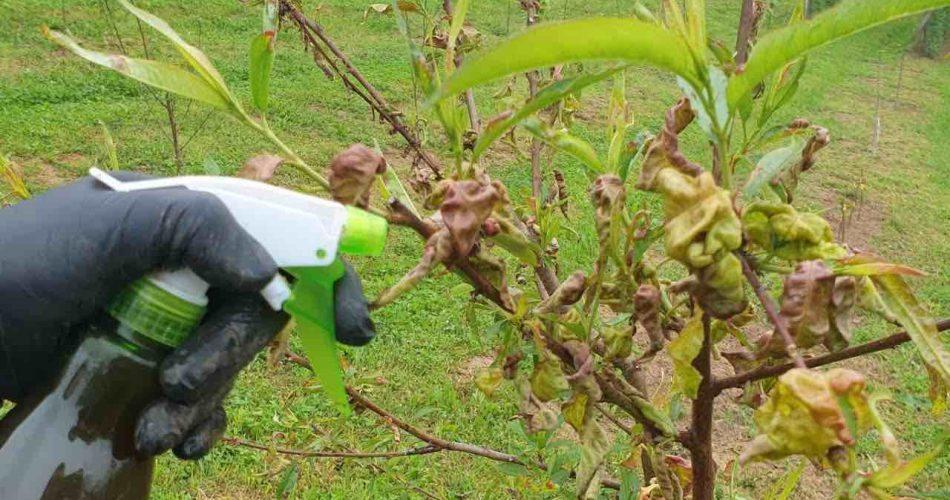
How to prevent peach leaf curl? Is it possible to treat it when it occurs? We will answer these questions. The problem of peach leaf curl is ubiquitous among all peach and nectarine growers.
This fungal disease can have a profound effect on all aspects of these tree plants, including flowers, fruits, leaves and shoots.
Gaining knowledge about peach leaf curl is an essential initial step in managing and eliminating this condition .
How to Identify Peach Leaf Curl
Identifying peach leaf curvature is a relatively simple task and does not require any specialized knowledge.
It only targets peaches and nectarines , making it easier to distinguish from other tree diseases. Despite its simplicity, it is one of the most pernicious diseases that could afflict your peach tree.
It usually occurs in spring when temperatures are low and rainfall is abundant.
As new peach leaves grow, they will be unusually thick and begin to curl, eventually taking on a wrinkled appearance .
Additionally, blisters will appear on the leaves, starting out yellow or reddish in color before later turning white.
Eventually, the entire leaf may take on various shades while developing a whitish coating.
In early summer, previously unsightly leaves will worsen by turning darker, shrinking , and eventually falling from the tree.
Sin
Sometimes new foliage appears after the diseased leaves have fallen, but trees affected by the disease tend to be brittle and unproductive . If fruit is produced, it will be deformed and covered with a number of defects.
The peach tree may experience significant weakness and a reduction in usable fruit yield due to several years of disease.
In some cases, the fruit may fall before it ripens . Although the tree may not necessarily die, you might consider cutting it down.
Signs and symptoms of curl
Typically, signs of peach leaf curl appear within two weeks of leaf emergence.
Symptoms of this condition involve leaf curling accompanied by a change in color.
Shades can range from yellow to purple, with discoloration being a common feature. In addition, there may be the presence of reddish warts on the leaves , which may become deformed.
In later stages, leaves may turn gray or develop a powdery texture.
Fruits may contract infections that appear as wart-like growths. These growths cause the fruit to become distressed and may even drop prematurely from the root.
Peach leaf curl not only affects the peach tree’s leaves, but it can also impact its new growth.
Affected shoots, for example, tend to be stunted and thick , while new branch tissue appears swollen and may eventually lead to death.
The ideal treatment
Although treating peach wart after symptoms appear is often ineffective, preventing this disease is simple .
To generally stop peach leaf curl, apply a fungicide spray in the fall after the leaves have fallen or just before spring budding.
Peach leaf loop
Generally, a single treatment during the fall is sufficient. However, areas sensitive to wet weather may require additional treatment in the spring .
Infections tend to be at their peak after rain, when spores are carried into the buds by the rain.
To prevent peach leaf curl, fungicides are therefore necessary. The question arises: which fungicides are most effective for this purpose?
The safest and most powerful fungicides for home gardeners are fixed copper products. These products may be labeled Metallic Copper Equivalent (MCE) on the packaging.
The MCE classification determines the strength of the fungicide; the higher the score, the more effective the fungicide. Lime sulfur and copper sulfate are the least effective options.