
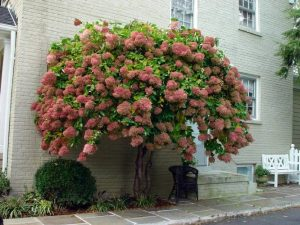
Want to plant a hydrangea? Is it possible? Learn everything from planting to pruning in this detailed guide.
Hydrangeas make excellent garden plants thanks to their blooms of varying shades. However, if you’re interested in teaching these plants how to grow taller, read on to learn how to grow a hydrangea!
What is a hydrangea?
A hydrangea is nothing more than a hydrangea flower that has been trained to grow and resemble a small tree. There is no such thing as a “hydrangea” that you can buy and plant directly in your garden, but you can certainly train this shrub to become a tree.
Learn how to grow a hydrangea?
- Choose the right variety
As we all know, hydrangeas are small shrubs that typically grow no taller than 60 to 120 cm. However, some varieties can reach impressive heights, and if you train them, the plants can easily resemble small trees!
Here are some of the best hydrangeas to grow as trees:
Rapid Fire : 6 to 8 feet high
Late : 8 to 12 feet tall
Pinky Winky : 6 to 8 feet tall
Small lime : 4 to 6 feet tall
Strawberry Vanilla: 7 to 10 feet tall
Pee Gee : 10 to 20 feet tall
Oak Leaf: 4 to 6 feet tall
Rail lights: 6 to 8 feet tall
Snowball: 3 to 5 feet tall
- Make sure they get the right amount of sunlight
Sunlight is to plants what food is to us. If plants don’t get enough light, they won’t grow big or strong.
If you want to grow hydrangeas as trees, it’s important to choose a location that receives 5 to 6 hours of direct sunlight in the morning and bright, dappled light the rest of the day. This ensures the plants receive enough light, which is essential for their growth.
- Size really matters!
Hydrangea TREE
Hydrangeas are shrubs that you prune and shape into a tree. It’s best to grow the plants from a young age, without thick main stems. To achieve a tree shape, cut off all the shoots from the base of the bush, leaving a long “stem.” If you prefer a rounded crown, cut off the branches closest to the main trunk and leave a few branches at the top. To maintain a beautiful and tidy “head,” it’s very important to carefully prune the tree once a year.
- Support in the early stages of growth
As the hydrangea grows, it may need additional support to prevent it from bending or breaking. Use stakes or a trellis for support from the beginning and make sure the hydrangea is securely anchored to the support structure.
Place the support near the plant’s main stem and secure it with twine. Make sure no tight knots form. Additionally, the support poles/stakes should extend at least 4 to 6 inches beyond the plant’s roots into the ground to ensure secure footing.
Support also protects plants from strong winds. Continue to support them until the plant has developed a thicker, stronger main trunk.
- Feed to stimulate growth
To promote growth, use a balanced liquid fertilizer diluted 1/4 and add it to the growing medium every 15 days.
The trick is to use a lower intensity and fertilize more often to promote plant growth.
You can also fertilize with a slow-release fertilizer in early to mid-spring and once in mid-summer to promote healthy growth and flowering.