
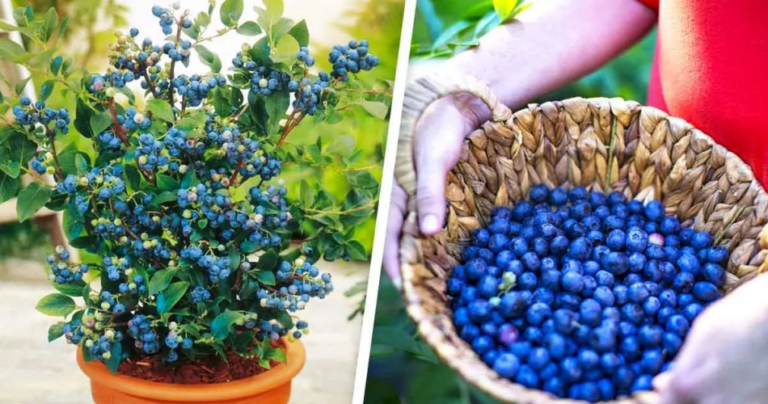
on How to grow blueberries in your garden?
Blueberries aren’t just found in the wild; don’t hesitate to plant them in your garden! Their leaves are good for your health, especially your eyesight, and their delicious fruits are rich in nutrients.
Here’s a good mountaineer, very hardy and not cold: the blueberry can withstand temperatures down to -25°C. It’s abundant in our region in the Vosges, the Alps, Auvergne, and Jura, where it grows up to 2,600 m above sea level. Like all heathland, it grows best in acidic soils, so it’s no surprise to find it in Brittany as well. Blueberries are a traditional summer crop, which explains the strong attachment to wild blueberries.
The gardener can plant a few meters to enjoy the sour berries, but there is better to do by planting varieties intended for the garden, especially those that come to us from the United States. They are the result of selection work begun at the beginning of the 20th century by American nurserymen who offer us beautiful blueberries, much larger than their wild cousins, the size of a blackthorn, produced by large shrubs that can reach 2m. Above all, these varieties have a low cold requirement, which allows them to be grown even in the plains, with very good yields. The “Champions” can produce up to 10 kg per plant!
Also read: The trick to keep cats away from the house with black pepper
Plant blueberries in your garden
blueberry
It is best to plant in autumn, when the soil is still warm deep down. This is also when the variety selection is wider in garden centers and nurseries. The shrubs are then offered in packaged clods, the roots wrapped in a peat sleeve, but sometimes the stumps are kept inside the warehouses, and buds begin thanks to the warmth there, while the normal cycle obviously involves budding in spring. They are also sold in containers. In this form, they can be planted almost all year round, taking care to water them when recovering. The blueberry needs cold, but be careful: its cycle still requires 160 days without frost. This is why it is important to avoid planting above 1000 m altitude. In terms of exposure, the wild form prefers shade, accustomed to undergrowth, while cultivated varieties are more comfortable in full sun, in an open area. The soil should be well worked, light to sandy and loose, preferably acidic to very acidic (pH between 3.5 and 5!). In neutral soil, blueberries grow satisfactorily, although the yield is lower.
Leave 4 feet between two feet for garden varieties to flower.
maintenance and size
blueberry branches
It’s always a bit of a pain to cut back newly purchased and planted plants. However, the best thing to do is to cut all the blueberry branches back to mid-length to plump up the bush. We’ll do the same the year after planting before continuing with maintenance pruning.
Otherwise, cornflowers are really very easy to care for. Just keep the soil slightly moist in summer by spreading mulch around the plants and watering, always at the plant’s base. Be careful not to wet the foliage to avoid encouraging the development of powdery mildew, a fungus that gives the foliage a white patina and which, in any case, appears almost every year.
Blueberries grow on the previous year’s wood. Each year, weak branches and dead wood should be removed, and branches four years old or older should be removed by cutting them back to the ground. However, do not touch other branches.
Harvest
The leaves are available year-round from wild blueberries, but remember that fruit varieties for the garden are obsolete: consider medicinal uses.
The fruits of the earliest varieties ripen from June and the harvest continues throughout the summer. Forget the shelf used for large harvests, a good harvest is achieved with patience, one berry after another, by hand, because not all have the same degree of ripeness. The yield varies greatly depending on the variety but also on the growing conditions and the nature of the soil. Expect between 300g per plant and 3kg for the super champions, with a reasonable value of 500g. And to think that the blueberry has been around for many years, up to fifty years, it is said.
Diseases and minor defects
You shouldn’t look everywhere for the bad, blueberries are mainly the target of powdery mildew, which is easily controlled. But there are also “powdery mildew years” when it’s hot and humid. One or two sprays of sulfur are generally enough; prefer the liquid form, which is much more practical. More serious, sclerotinia, or sclerotinia rot, is caused by a fungus present in the soil. In this case, you have to cut back and move to the other side of the garden to install a whole new patch, with healthy plants!
The best varieties
Almost all American blueberry varieties are self-fertile. However, productivity increases if several varieties are planted, for example, three.
Early varieties
Blue
Cold-resistant. Medium-sized, light to dark blue fruits with firm, acidic, and subtly aromatic pulp. Harvested in the second half of June. Fairly susceptible to sclerotinia.
Patriot
Very hardy (-29°C) but sensitive to late spring frosts. Large, well-colored, firm berries with slightly acidic pulp. Harvested in the last week of June.
Mid-season variety
Blue cutout
A very productive variety created in 1941, it is one of the best blueberries for the food industry. Firm berries, good resistance to rain, resistant to splitting. Very blue skin, spicy and fragrant pulp. Harvested in the first three weeks of July. Good resistance to sclerotinia and cold (down to -30°C).
Ivanhe
Very large blueberries with firm, fruity, and spicy flesh. Dark blue skin. Harvest throughout July.
Late varieties
Pullover
blue culture
Medium-sized, light blue berries with a fragrance that only reveals itself late at full maturity. Follows “Bluecrop,” for a four-week harvest.
Darrow
Very large dark blue berries, firm pulp, unparalleled aroma and flavor, undoubtedly one of the best blueberries. Good productivity, harvested from mid-July and extended for six weeks.
Wild blueberry
wild blueberry
It is a shrub no taller than 30 cm, which offers abundant production. Small black fruits, with purple pulp, sweet and sour and slightly astringent, its juice stains a lot. Harvest from late August to mid-September.
blueberry
Blueberry, Cornflower, Blueberry, Brimbelle, Bilberry, Vaccinium myrtillus L., M. corymbosum L. Ericaceae.
Shrub forming a large, upright bush of 1.50 m to 2 m. Leaves are evergreen in the wild species, deciduous in the cultivated blueberry, oval, elongated, 2 cm wide and 6 cm long. White, waxy, bell-shaped flowers, gathered in clusters, followed by spherical berries 1 to 2 cm in diameter, black, covered with a prominent white bloom.
Also read: How to grow tulips in water?
Its advantages
Highly rich in antioxidants, it protects blood vessels and helps treat inflammation, hemorrhoids, varicose veins, rosacea and anything related to blood circulation in general, also against eye fatigue and diarrhea.
Grow it in a pot
If you’re looking for leaves and not berries, you can easily grow a potted plant on a terrace or large balcony. We’ll obviously choose a wild cornflower (therefore evergreen). Repot in so-called heather soil (the same soil used for camellias or hydrangeas) in a pot 30 to 50 cm in diameter. Place a 5 cm drainage layer (gravel, pot shards, clay pebbles, etc.) at the bottom. Provide a partially shaded exposure.
Also read: Practical guide to planting lemon seeds in pots