
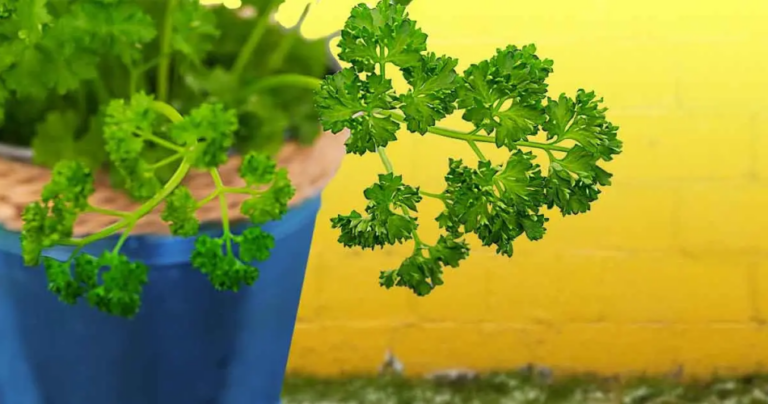
Parsley is one of the most beloved herbs in the kitchen. It brings a real touch of sunny flavor, seasoning our salads and meats and flavoring all our culinary recipes, from the simplest to the most sophisticated. Without it, our dishes would be rather bland. Without a doubt, this aromatic herb is indispensable all year round. But now imagine not having to buy it anymore. Growing your own parsley at home would be a game changer, wouldn’t it?
Winter and summer alike, we love sprinkling fresh herbs into our dishes. They make our food taste better and more flavorful. Parsley is one of the most important ingredients in cooking. It’s hard to live without it. While it’s not too expensive, it can be costly in the long run. So, the idea of having it free all year round isn’t a luxury!
Don’t have a vegetable patch, or even a garden? Don’t worry, parsley can be grown in pots at home. As a bonus, it’s very easy to grow this herb on a windowsill. And caring for it isn’t rocket science!
Also read: The trick to keep cats away from the house with black pepper
Find out in this article how to grow parsley at home so you always have some at home.
Choose the right variety
Not all parsley varieties are equally suitable for indoor planting. Low-growing varieties are best. They also look great on a windowsill because they don’t stretch too much.
Choose a pot for your parsley
potted parsley
You can use any empty pot or container. There’s only one rule: the more parsley you want to grow, the larger the planting pot should be. However, choose a vase that fits perfectly on a windowsill. It should have several drainage holes and some sort of saucer to catch any water leaks.
Start sowing parsley
parsley
Fill the pot with good-quality potting soil: add a layer of drainage or clay to the bottom of the container, then fill the pot with potting soil to within 5 cm of the top. To improve drainage, you can add a handful of sand.
Sow a large number of seeds. Then moisten the pot with water. Cover the seeds with another 2 cm of soil.
Moisten the soil again with water from the sprayer. Cover the pot with a bag, a clear lid, or a glass and place it in a warm place to germinate. Ideally, place it in a semi-shaded area.
Water the pot regularly to keep the soil moist. Seedlings will emerge after about three weeks. Caution: If you notice too many seeds, cut off the excess with scissors.
Caring for parsley
take care of the parsley
After 2 to 4 weeks, the first shoots will appear. Immediately remove the lid from the pot and place it in a bright location. Note that parsley grows best in the sun, with about 6 to 8 hours of direct light per day. If the window where the pot is placed does not receive much light, it is best to provide artificial lighting.
Water the plant sparingly and only when the soil is dry. If your parsley is growing near a kitchen window, humidity is high, especially from cooking steam and constantly running water. If it’s growing elsewhere, remember to water it occasionally, especially if the leaves look dry. Remember to empty the saucer under the pot after each watering to prevent the roots from getting too wet.
Fertilize parsley with a natural fertilizer. If you like, you can also combine it with other aromatic herbs such as oregano, chives, basil, or mint. Nothing is more beautiful than a windowsill filled with fresh herbs!
What are the varieties of parsley?
This herb comes in three different types: smooth parsley, curly parsley, and parsley whose usable part is the root. These three varieties are generally sown throughout the year; they are fast-growing, very productive, and very cold-resistant plants.
Common or smooth-leaved parsley has abundant, dark green foliage. Its upright stems can reach up to 40 centimeters in height. Its leaves are the edible part used as a condiment. They are dark green, large, smooth, and have serrated edges that also have long petioles. They are very aromatic and have a very pronounced, characteristic flavor.
Also read: Get rid of cockroaches coming out of the sewers – 1 tablespoon of this ingredient is enough
Curly parsley, or Chinese parsley, has very cut and extremely curly leaves. Its foliage is lighter green and has a weaker growth habit than that of common parsley. Its stem is upright and compact. This parsley is a little less aromatic but is more commonly used as a garnish. It is recommended to macerate the seeds for 24 hours before sowing them.
Finally, the last variety is very special: it reveals a very thick root which is used in cooking as a vegetable or to season a dish, but which is never eaten raw.
Also read: This scent will keep silverfish away once and for all and your bathroom will smell good