
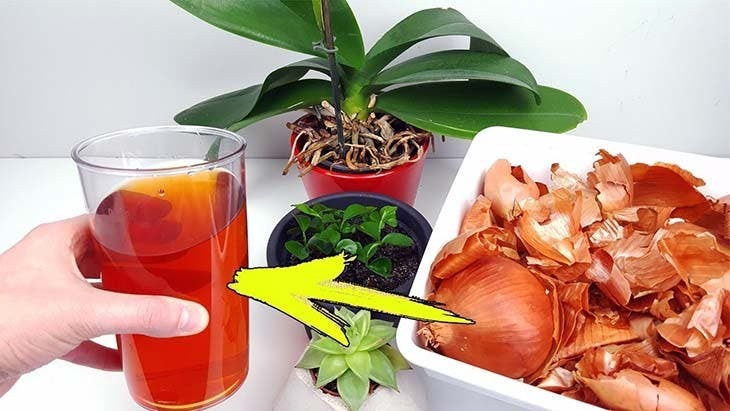
To keep your plants healthy, it’s essential to place them in a sunny spot. It’s also important to water them well and provide them with a good fertilizer. There are many varieties available. You can make it at home and grow your plants quickly.
This is why we are going to present to you an effective, practical, ecological and economical technique with onion peeling.
onion peel
Pinterest Logo
Onion skins – Source: spm
Ingredients needed to make a natural fertilizer to fertilize plants:
Onion skins
1 liter of water
A plastic bottle
A colander
natural fertilizer for plants
Pinterest Logo
Natural fertilizer for fertilizing plants – Source: spm
Preparation and use:
You will first need to collect the onion peels after each use and fill a medium-sized bucket.
Once stuffed, cut them with a pair of scissors so that they come out in small pieces.
Place them in the plastic bottle into which you will pour a liter of water.
Let the mixture sit in the open air for 24 hours.
Then filter the mixture. To do this, you can use a filter cloth or simply a colander.
Now you have the best fertilizer for all types of plants, including indoor and outdoor plants.
This solution can be used for up to two weeks. After this time, you will need to discard it and repeat the process.
This natural fertilizer should be kept in the refrigerator when not in use.
You can water all kinds of plants. Whether large or small, flowering or not, it allows you to observe constant growth.
It is recommended to use this onion water every 20 days.
Keep in mind that in order for your plants to grow healthy and strong, you should consider the following tips:
indoor plant pots
Pinterest Logo
Potted plants at home – Source: spm
Plant care tips:
1 – Light
For photosynthesis to occur, the plant needs light. (insert hyperlink)
Without light, your plant will inevitably die.
Broad-leaved plants generally do not need a lot of light because they contain more chlorophyll.
2 – Substrate
Soil texture is essential. That’s why the most fertile soils are the best for your plants.
Clay soils are more compact and therefore more likely to absorb water.
Finally, there are sandy soils, which do not absorb water and nutrients. Therefore, a large amount of fertilizer will be required.
3 – Water
Water is a source of vital minerals for plants. Through their roots, they draw water from the soil.