
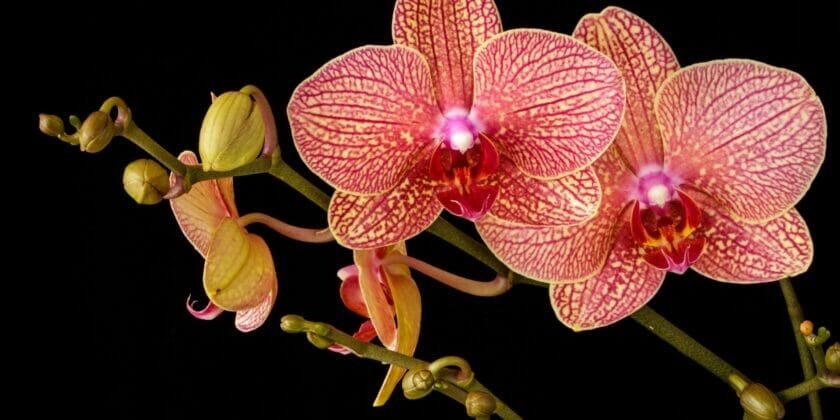
Sometimes we think of orchids as extremely delicate flowers that require constant attention. This is partly true, but on the other hand, the orchid is also a very strong and resilient plant. Sometimes you might get so sick that you think there’s nothing more you can do. In these cases, instead of throwing it away, here’s how to save and revive a dying orchid without flowers and with dry leaves.
The orchid is a flower that resembles a model ready for a fashion show. Its beauty is readily kept at home to highlight a point of the house. However, haste and distraction can cause some discomfort. So, let’s not be surprised if the orchid loses flowers, withers, and dies due to these mistakes.
The plant only dies if all the flowers have fallen off, the leaves have dried up, and the roots are eaten away by rot. It’s not a pretty sight, but in this case, there’s not much you can do.
On the other hand, if there is at least one green leaf left on the plant, do not throw it away, because the plant is not yet dead. Perhaps with a little attention, you can recover.
Content Index
Instead of throwing it away, here’s how to save and revive a dying orchid without flowers or dry leaves
Repotting the orchid
Instead of throwing it away, here’s how to save and revive a dying orchid without flowers or dry leaves
When only one or two leaves remain on the plant, it’s best to take immediate action to save it. It’s perfectly normal for an orchid to lose all its flowers at a certain time of year. It’s not normal for the leaves to dry out along with the flowers.
To recover an orchid plant that only has one or two leaves left, proceed as follows. First, free it from the pot by removing all the soil. Now let’s check the aerial roots, which should be dead, but not all, if there is still a green leaf.
Using disinfected scissors, we cut off the remaining dead roots and dry parts, leaving the remaining living parts. After cleaning, we now prepare the new location for sowing.
We take a transparent glass, into which we pour 4 parts of water and 1 part of hydrogen peroxide. The latter serves to ensure a safe environment for the plant, but also to accelerate the growth of the roots. The water should only cover the roots without touching the leaves, otherwise they will rot.
We leave the seedling in water for about 40 days. We will see that the roots have recovered and perhaps new ones have sprouted. The leaves are also in great shape.
Repotting the orchid
At this point, it is necessary to place the orchid in the vase. You can get a new pot and new soil. A little soil is placed at the bottom and then the seedling is placed, bringing the soil level under the leaves. It is watered and little by little, over the months, the orchid will regain its life and beauty.