
on Mother-in-law’s tongue, how to reproduce it endlessly: the real method used by nurseries
How to reproduce mother-in-law’s tongue endlessly? Nurserymen explain the method that anyone can apply directly.
Mother-in-law’s tongue is one of those plants that enriches any environment. Experienced nurserymen teach you how to propagate a cutting quickly and fun. Obviously, these are actions to be carried out even if you don’t have a developed green thumb . To have a plant of this type indefinitely, without having to buy it, there are a few steps to take: let’s discover together.
Mother-in-law’s tongue, plant characteristics
Mother-in-law’s tongue, a plant recognizable by its vertical growth, has a peculiar name. It was given this name to give it a personal interpretation. Indeed, its stems are toothed and narrow, with vertical growth and no branching. A plant that certainly attracts attention, given its brightly colored flowers composed of numerous petals, which only open during the day.
Reproduction of mother-in-law’s tongue
The predominant shades can be numerous, from yellow and white to red and romantic pink. The classic colors are white, with a trumpet shape and dimensions that vary depending on the type.
Speaking of different types, there are some that produce fragrant, pure white flowers that only open at noon . In short, a real spectacle.
The expert method
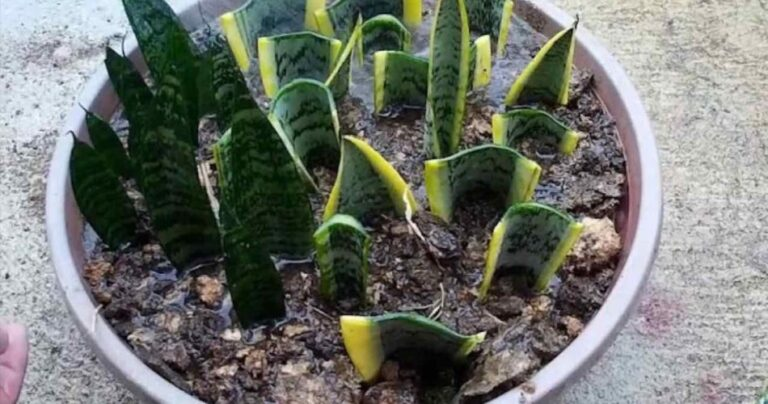
How is the plant propagated? Usually, a cutting from a healthy, mature, and robust plant that has already developed its flowers is used. This is done by taking a part of the plant and sheltering it for 7 days. The perpendicular cut, made with sharp, disinfected scissors, should heal slowly. After a week of rest, plant this cutting in a pot with fertile, sandy soil.
Mother-in-law’s tongue cut
The soil should always be moist, trying to take root within two weeks. Remember that this is a plant accustomed to the tropical climate , so it is preferable that it lives in humid environments and not in full sun. Also be careful of the cold which is not favorable to the plant.
This plant can therefore be propagated indefinitely , but if in doubt, it is advisable to seek advice from a trusted nurseryman. Cutting a cutting should not be rushed and, above all, the cut should not be sharp.
Several cuttings can also be planted together, so as to form a seedling team that takes root within two weeks. The rooted cuttings can then be planted individually in a pot, while those without roots have not developed and cannot continue on their way.