
on Propagating Guavas by Aerial Layering Using an Orange
share 3
Air layering is a popular technique used by gardeners and horticulturists to propagate plants, including fruit trees like guavas. This method allows new roots to develop on a branch while remaining attached to the mother plant, ensuring a high success rate when transplanting. What makes this method even more fascinating is the innovative use of a simple orange, serving as a makeshift mold to hold the air layering material in place. In this article, we will explore the step-by-step process of propagating guavas through air layering using an orange, a technique that has gained popularity among gardening enthusiasts.
Materials needed:
Guava tree with a branch suitable for air layering.
Fresh orange, cut in half.
Coco peat mix (coconut peat mixed with water).
Plastic wrap or a plastic bag.
String or zip ties.
A pair of pruning shears.
The step-by-step process:
Select the branch: Start by identifying a healthy, suitable branch on your guava for air layering. This should be a branch you want to propagate and grow as a new plant.
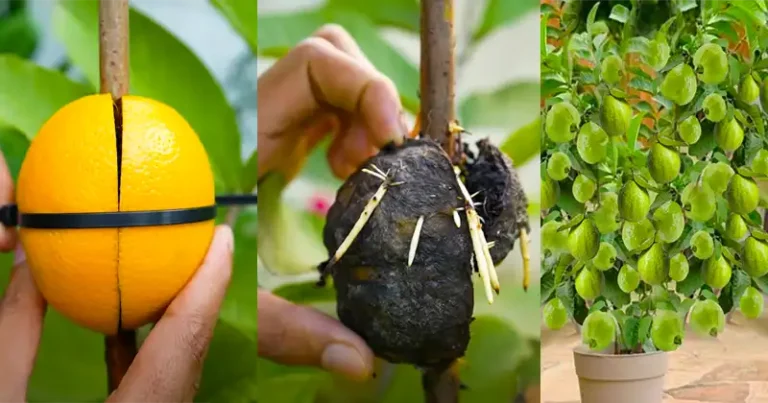
Prepare the orange casting: Take a fresh orange and carefully cut it in half. Remove the inner fruit, leaving two empty orange halves. These will act as your “casts” to hold the air layering material.
Fill with coco peat mix: Prepare a moist coco peat mix by mixing the coco peat with water. The consistency should be moist but not too wet. Fill both halves of the orange with this coco peat mix. Make sure it is tightly packed, but not too compacted.
Assemble the orange mold: Place one half of the orange on one side of the selected branch and the other half on the other side, effectively sandwiching the branch. The coco peat mixture inside each half will come into contact with the branch. This configuration will hold the air layering material securely in place.
Secure with string or zip ties: Use string or zip ties to firmly secure the two halves of the orange around the branch. Make sure it is tight enough to hold the coco peat mix in place and maintain contact with the branch.
Create a mini greenhouse: To create the optimal environment for root development, wrap the entire plant in plastic wrap or a plastic bag. This acts like a mini greenhouse, trapping moisture and warmth, which encourages root growth.
Wait for roots to develop: Leave the air layering setup alone for about 40 days. During this time, make sure the film or plastic bag remains intact and moist. The branch will develop roots during this time.
Check root development: After 40 days, carefully remove the film or plastic bag and the orange plaster. You should see that the branch has developed a set of healthy roots. These roots are now ready for transplanting.
Transplant the new guava plant: Using pruning shears, cut the branch below the newly formed root system. The branch with its roots can now be potted or planted in a suitable location, where it will grow into a new guava tree.
Conclusion
Propagating guavas by air layering with an orange is an ingenious method that allows gardeners to create new plants with a high success rate. This innovative approach not only simplifies the process but also demonstrates nature’s resilience and adaptability. So, if you’re looking to expand your guava orchard or share this fascinating method with other gardeners, try air layering with an orange and enjoy the satisfaction of growing your own guavas from established branches. Happy gardening!