
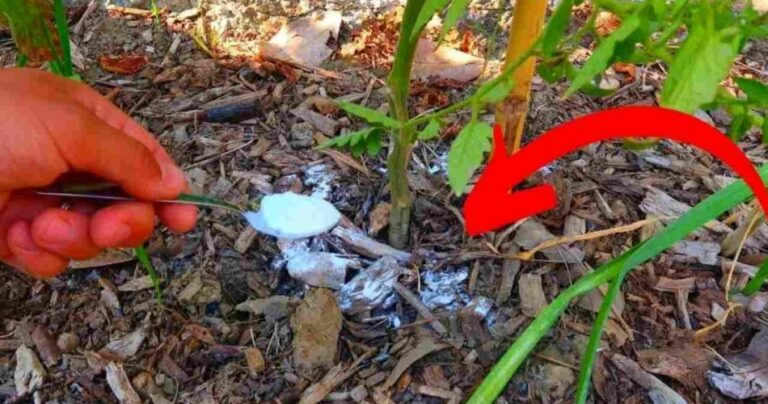
Why put baking soda on plants? There’s a very specific reason why we should always do this.
Baking soda is a versatile product found in every home. It excels at performing a wide range of functions, including cleaning various surfaces and effectively softening dried vegetables.
It also provides relief as a digestive aid after consuming a particularly large meal.
Many people are unaware that bicarbonate can be a valuable tool in the ecological protection of gardens, orchards and plants .
Its effectiveness is particularly evident in its ability to combat powdery mildew, a common pathogen that affects a variety of plants including vines, zucchini and sage.
In agriculture, there are two distinct forms of bicarbonate: sodium bicarbonate and potassium bicarbonate .
Although these compounds are similar in nature, they have specific purposes, particularly in the fight against fungal diseases.
Their properties make them an optimal choice for organic farming, as they offer effective fungicide treatment.
Finding baking soda is easy, and it’s also an affordable option. Plus, it’s an ideal choice for home gardens and regular gardens .
Now let’s explore the distinctive characteristics of baking soda and compare it to potassium bicarbonate.
Additionally, we will discuss the appropriate situations for its use and the appropriate methods for performing treatments.
Potassium bicarbonate and sodium bicarbonate
When it comes to bicarbonate, it is important to distinguish between baking soda and potassium bicarbonate.
Although these two compounds share similarities , they vary both in their molecular structure and their official classification for their agricultural applications .
Sodium bicarbonate, chemically known as the sodium salt of carbonic acid, is a fine, white, odorless powder that can be dissolved in water at room temperature.
It is derived from the combination of sodium carbonate, water, and carbon dioxide. In agriculture, sodium bicarbonate is classified as a ” tonic ” and is considered an activator of plants’ natural defense mechanisms.
Put baking soda on a seedling
This classification is specified in Annex 2 of the new DM 6793, dated 18/07/2018, which incorporates existing European legislation governing the organic sector in Italy .
Potassium bicarbonate is a derivative of carbonic acid, specifically derived from potassium carbonate.
Unlike baking soda, it is primarily considered a pesticide rather than a tonic. Therefore, it falls under the purview of existing pesticide regulations.
Fortunately, its effectiveness is limited to a single day, which allows the treatment to be carried out before the fruit is ripe .
It is important to note that the term “ripe” refers to the designated time interval, measured in days, between final processing and harvest.
If professional farmers have a “permit”, a document issued after specialized training, they can use pesticides.
Conversely, hobby farmers currently do not need such authorization and have access to product formats other than those intended for professional use.
However, since the PAN (National Action Plan) came into force in 2015, which effectively regulated and restricted the entire pesticide industry , even in conventional agriculture, the range of products available for purchase by individuals has decreased considerably.
Therefore, this has limited the reckless use of harmful, polluting and health-damaging substances.
In this way, people are encouraged to opt for more environmentally friendly alternatives when maintaining their gardens, orchards and lawns.
Why put baking soda on plants?
There are two variants of baking soda that are used to protect plants against certain fungal or cryptogamic diseases.
By increasing the pH of the liquid solution, the presence of bicarbonate generates unfavorable circumstances for the growth and expansion of harmful fungal mycelia .
Bicarbonate on plants
This, in turn, leads to their dehydration and subsequent prevention of further spread.
How treatments should be carried out
For treatments using both bicarbonate variants to achieve the desired results, it is essential that the intervention takes place quickly, as soon as the first signs of the disorder appear.
The effect is essentially preventative and serves to inhibit further progression , but does not have the ability to restore plants that have already suffered significant damage.
The use of sodium bicarbonate depends on the desired concentration, which varies from 500 g to a maximum of 1500 g per hectoliter of water .
These recommended quantities are applicable to large areas using spreading machines, but the same proportion also applies to small-scale crops.
For example, when preparing a solution in a 1 liter spray bottle, it is recommended to include 5 to 15 g of baking soda . Conversely, using a 15 liter backpack pump, the ideal amount would be approximately 75 to 225 grams .
When using any type of plant protection product, whether ecological or not, it is essential to respect the recommended dosage.
Even seemingly harmless substances like baking soda can cause burns if applied excessively and can lead to an increase in pH if they accumulate in the soil over time. Similar problems occur with excessive use of potassium bicarbonate.
Regarding potassium bicarbonate, the commercial product label provides recommended dosages for various species (although there may be variations) and necessary precautions for use .
To ensure the effectiveness of the treatments, it is essential to carry them out during the coolest periods of the day.
It is particularly important to avoid treating plants when ambient temperatures exceed 35°C , as this could potentially lead to a detrimental effect on plants known as phytotoxicity .
This limitation presents a challenge when controlling powdery mildew in cucurbits during the summer, as even sulfur treatments may not be sufficient at extremely high temperatures.
In such cases, it is necessary to wait patiently for the cooler days and in the meantime remove the most affected leaves.