
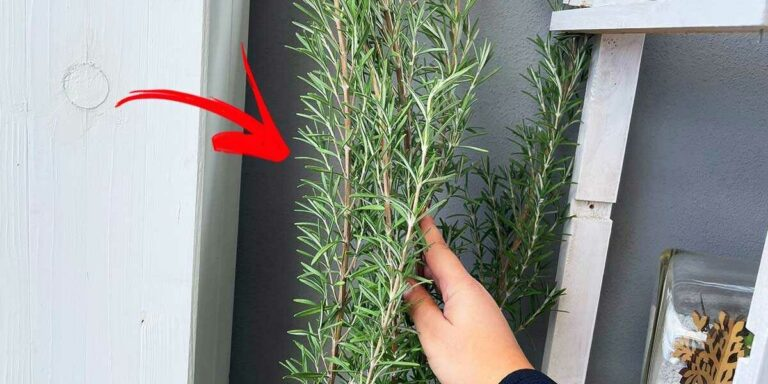
No plant can fill your home or balcony with an intense aroma like aromatic plants : medium/small in size and easy to grow, they can form a ” small vegetable garden ” so you can use their leaves to flavor your dishes.
Among the most well-known aromatic plants, we obviously find rosemary which, with its small elongated leaves, adorns our balconies and terraces, giving off a wild, slightly spicy but extremely pleasant scent.
Sometimes, however, our potted rosemary appears wilted, with a slightly bare crown and few leaves. Let’s see together what to do to make it thick and well-scented .
Top tips for spring
One of the main things you can do to stimulate its growth and make it thicker is to prune the tips , that is, to cut off the upper ends of the tallest branches. This will help the plant grow more compact and become bushier .
So this is not a real pruning operation, which this plant does not need at all. When pruning rosemary, always use clean shears or garden shears .
Repot every 2-3 years
When you don’t repot rosemary for many years, its growth may slow or stop and its leaves may wilt, losing their classic, wonderful fragrance.
Every 2-3 years, repot the plant using a pot a little larger than the previous one, but above all, change the soil. Use a substrate composed of universal soil mixed with sand , placing expanded clay at the bottom of the pot to facilitate the drainage of the plant and avoid water stagnation .
Fertilize it from March
Another very effective solution to stimulate the growth of fragrant leaves is to fertilize the plant . There are many specific fertilizers on the market to stimulate the vegetative activity of aromatic plants: you can safely use them for your rosemary from March .
However, if you don’t have any specific fertilizer at home and want to remedy this as quickly as possible, you can use a natural fertilizer made from coffee grounds: simply crumble it and spread it on the soil to stimulate the growth of new, fragrant leaves thanks to the “high nitrogen content ” they contain.
Avoid excessive heat
Rosemary is a perennial plant , so it does not lose its leaves in cold weather . However, it does not tolerate hot, humid summers.
If the temperatures are excessively hot, rosemary undergoes the phenomenon known as aestivation , that is, it enters a sort of summer rest phase during which its growth stops and its appearance appears drier and bare.
One way to avoid this phenomenon is to keep your rosemary on your terrace or balcony, placing it, on very hot days, in a fairly shaded area, away from the sun’s rays.
Also, avoid keeping this plant indoors during the cooler months, especially if your home is heated, or you risk it wilting .
Protect it from pests
Especially from March onwards, this plant can be attacked by certain parasites , including the terrible aphids, which feed on its sap, weakening it. The consequence is that the plant appears more bare, the leaves become thinner and the foliage is less dense .
You can act quickly by using a specific product against plant parasites or by using certain natural products such as Marseille soap: simply dissolve 20-30 grams in approximately 500 ml of water , put everything in a spray bottle and spray it on the plant.