
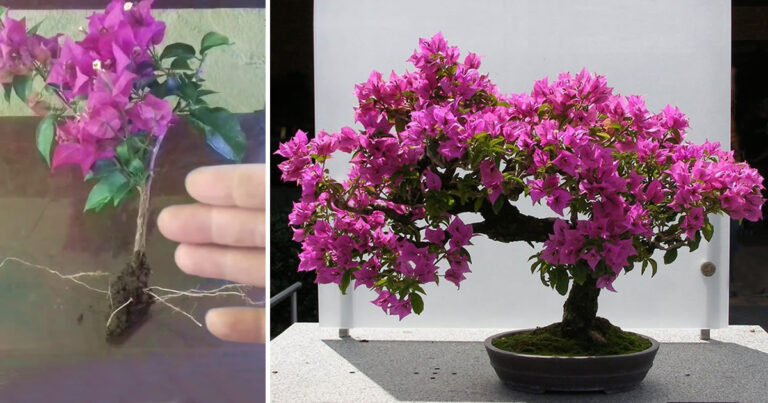
About 18 different types of plants belong to the bougainvillea genus , all native to South America and all capable of offering us a unique and wonderful spectacle through their flowering.
These climbing shrubs can reach 12 meters high and, depending on the climate, can flower all year round. In a climate like ours, they bloom from spring to late autumn.
Contrary to what it may seem, bougainvillea flowers are small and white, surrounded by bracts that take on different colors and have a papery consistency.
Bougainvillea needs full sun to flower well . For this reason, this species should not be treated as an indoor bonsai.
The bougainvillea bonsai must be protected from frost and wind. In any case, do not worry if the plant loses its leaves during the cold months: this is part of its life cycle.
Bougainvillea Bonsai Soil
Bougainvillea have a very fine and sensitive root system, so it is essential to use a porous and acidic potting soil.
You can choose a solution composed of akadama and add 30% of kiryzuna or kanuma.
Watering the Bougainvillea Bonsai
Water when the topsoil begins to dry out. It is important to keep the soil moist, but avoid waterlogging.
Remember to use reverse osmosis water, as the presence of dissolved salts in the water could alter the pH of the soil.
Pinching and pruning the bougainvillea bonsai
Bougainvilleas are climbing shrubs and therefore tend to form shoots at the tips, which in turn serve to cling to other trees.
To form the structure of the bonsai, pinch the acids more intensively, to be able to distribute the “force” on the lower branches. Carry out pinching after flowering.
A two-bud pruning is recommended to strengthen the plant and stimulate the growth of new branches directly from the old trunk.
Bonsai Wiring
It is not recommended to wire a bougainvillea bonsai excessively, as its branches break easily or may dry out due to the wire.
In any case, do it on still tender shoots to give direction to their growth.